What to pack for St Barth: a practical list for a villa stay
Small-plane luggage limits, entry papers, climate, hurricane season and what to wear: a packing list for St Barth built on verifiable sources.
By Sun Beach House
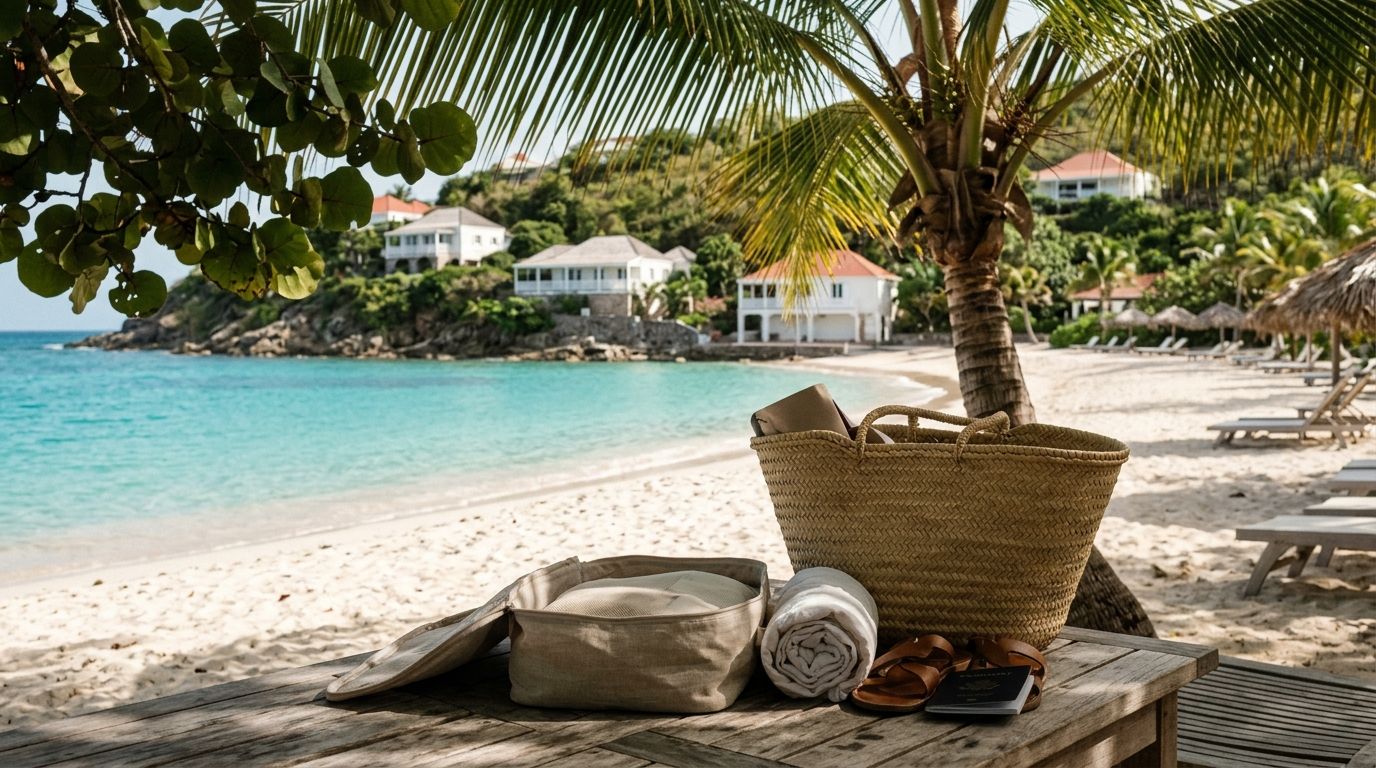
On the runway at Saint-Jean, it is not the suitcase that decides, it is the scale. The airport sits in the bay of Saint-Jean[1], and the regional airlines that land there fly small aircraft with limited cargo space: each sets its own weight limits[10][11]. Better to know that before you fill your bags than at the check-in counter.
This article answers a simple question, what to put in your suitcase for St Barth, relying only on what the airlines, official bodies and the press say. It complements our guide to getting to St Barth: here we look at what you bring, not how you arrive.
Luggage first: what the airlines allow
The limits below are those published by the airlines on their official pages at the time of writing. They may change and sometimes depend on the fare: always check your ticket.
| Airline | Checked bag | Cabin bag | Worth noting |
|---|---|---|---|
| St Barth Commuter | 23 kg (50 lb) | 12 kg (26 lb) | Same limits on Basic and Flex fares[7] |
| Winair | 23 kg (50 lb) per bag | See the airline's carry-on page | Between 23 and 32 kg: accepted subject to space, for a fee[8] |
| Tradewind Aviation | 23 kg (50 lb) in total per passenger, carry-on and personal item included | Personal item: 6 x 9 x 17 inches maximum | Any wheeled luggage must be checked in[10] |
| Air Inter Iles | 32 kg in total, split between checked and cabin depending on the fare | 12 kg (26 lb) | 20 kg checked if the cabin bag weighs 12 kg[11] |
A few points deserve attention.
- Total weight is not counted the same way everywhere. At Tradewind, the 23 kg covers everything you carry: the airline's own example is a 30 lb checked bag, a 15 lb "carry-on" and a 5 lb personal item[10]. At St Barth Commuter, checked and cabin allowances are listed separately[7].
- Extra bags are never guaranteed. Winair places excess baggage on stand-by: it is loaded only if the aircraft's weight and balance and volume allow it, and no single bag over 70 lb (about 31 kg) is accepted[9]. Air Inter Iles warns that some luggage may be unloaded and re-routed on the first available flight[11].
- Bulky equipment needs advance planning. Air Inter Iles accepts special baggage (surfboards, kiteboards, golf clubs, strollers) subject to available space, with a maximum length of 130 cm[11]. Tradewind asks you to call ahead if you plan to bring golf clubs, with no guarantee they will travel[10]. For extra volume, Tradewind suggests buying an additional seat or flying private[10].
Our advice, which follows directly from these rules: put in your cabin bag whatever you would not want to see arrive on the next flight, namely your documents, your medication, a swimsuit and your charger. Air Inter Iles also recommends soft bags for the bag that goes under the seat[11].
Documents and formalities: cabin bag first
Saint-Barthélemy is a French overseas collectivity, but the island is not part of the Schengen area. The Saint-Barthélemy tourism board states that all travelers must hold a valid passport and that, depending on nationality, a French visa may be required, issued before departure and bearing the mention "Collectivité territoriale de Saint-Barthélemy et Saint-Martin". A standard Schengen visa is not valid[1].
According to the same body:
- US and Canadian citizens: a valid passport with a return or onward ticket; no visa for stays of 90 days or less; the passport must have more than six months' validity at entry[1].
- British citizens: no visa for tourist or business stays of up to 90 days[1]. The UK Foreign Office, for its part, states that the passport must expire at least three months after the date you leave the island[3]. The two rules differ: follow the stricter one.
- French travelers: the Justice.fr website specifies that a valid passport is required when transiting through the Dutch side of Saint Martin (Sint Maarten), even if you do not go through border controls[2]. Yet most travelers reach the island by a transfer from Saint Martin, Guadeloupe, Antigua or Puerto Rico[1].
Two other formalities are easily forgotten:
- The Sint Maarten entry form. Anyone setting foot on the territory, including in simple transit, must complete it before their flight, with each traveler filling in their own form, including within a family[1].
- Yellow fever. The UK Foreign Office states that a vaccination certificate is required to enter St Martin and St Barthélemy if you are arriving from a country listed as a transmission risk[3].
One last practical point: the currency of Saint-Barthélemy is the euro. IEDOM, which carries out central banking missions on the island on behalf of the Banque de France, notes that the monetary agreement of July 12, 2011 between France and the European Union maintains the single currency in Saint-Barthélemy[4].
Climate: adapting your suitcase to the season
A February 2026 note published on the DRIAS portal describes the northern islands (Saint Martin and Saint-Barthélemy) as having a warm, sunny tropical maritime climate all year round, under the influence of the easterly trade winds[5]. Two seasons structure the year:
| Season | Period | Temperatures | Rain |
|---|---|---|---|
| Carême (dry season) | January to April approximately | Minimums around 21-24 °C, maximums of 28-31 °C | Infrequent rainfall |
| Hivernage (wet season) | June to November | Minimums close to 25-27 °C, maximums of 31-33 °C | Sometimes intense but generally short showers |
Source: DRIAS portal, February 2026 note[5].
Annual rainfall averages between 800 and 1,500 mm, with a rainfall pattern that varies widely from year to year, and significant rainy episodes can occur between the two seasons[5]. In practice, these temperatures leave little room for heavy layers: what matters is choosing light fabrics. For days when the sky clouds over, we have gathered eight ideas for rainy days. For the 2026-2027 calendar, see our guide to high season in St Barth.
Hurricane season: what it changes for your suitcase
The 2025 hurricane season officially began on June 1 and ended on November 30[6]. The DRIAS note also links the hivernage, from June to November, to the Atlantic hurricane period, during which the northern islands are regularly exposed to storms and hurricanes[5]. If you travel in October or November, you are therefore still within that window.
It does not call for a different suitcase, but for a few habits:
- Stay informed. Le Journal de Saint-Barth recalls that a vigilance scale exists (yellow, orange, red, purple, then gray after a hurricane has passed), with Météo-France bulletins, and that the emergency frequency is 91.1 FM[6]. The president of the Collectivité urges everyone to register with Cedralis, a free alert system[6].
- Keep the essentials on you. The preparedness list published by the Journal, written for residents, includes ID papers and a photocopy, current medication, a charged phone with its charger, and cash[6]. Those four items fit in a cabin bag.
- Ask your villa. Before you arrive, ask your villa manager which instructions apply in case of an alert.
Clothing and shoes: the consensus of those who come back
No official rule sets what to wear in St Barth. The most precise advice we found comes from a W Magazine guide, which interviewed the owner of Le Toiny and three regular visitors to the island[12]. These are personal opinions, presented as such.
- The style, in two words. Charlie Vere Nicoll, owner of Le Toiny, speaks of "effortless elegance": lightweight linen or cotton pieces by day, resort-chic for dining out, and clothes that move easily from day to night[12].
- The minimal formula. Andrea Linett sums it up: two bikinis, a couple of pareos, a few good t-shirts, something diaphanous for the evening, flip-flops, and shoes that are a little fancier but still flat[12].
- Flat, preferably. MoAnA Luu, who has been coming for 20 years, puts flat shoes at the top of her list: they suit chic evenings as well as hopping on and off boats. She finds heels impractical on sandy paths, wooden decks and beach bars[12].
- Leave at home. Formal dresses and heavy makeup, according to Charlie Vere Nicoll[12].
- Keep room for. Andrea Linett advises leaving space in your toiletry bag for pharmacy products, which she names as her favorite shopping experience[12].
Jayma Cardoso, another regular quoted by the magazine, recommends greeting people with a "bonjour"; life there is that of a small community, where respect and friendliness count[12].
A local rule to know: dogs and beaches
If you travel with a pet, the Saint-Barthélemy tourism board notes that dogs are prohibited on all the island's beaches (Decree No. 86-27 of March 19, 1986)[1]. It also details the formalities: rabies vaccination, microchip identification, and a health certificate issued within five days before departure[1]. Each airline also sets its own conditions for animals: check before you book.
The list at a glance
In your cabin bag
- Valid passport, with the validity period required for your nationality[1][3]
- Return or onward ticket if you are American or Canadian[1]
- Confirmation of the Sint Maarten entry form, completed before the flight[1]
- Current medication and phone charger[6], a swimsuit
- A soft bag for the item that goes under the seat[11]
In your suitcase or travel bag
- Lightweight linen or cotton clothing, an outfit for the evening[12]
- Swimsuits, pareos, flip-flops[12]
- Flat shoes, a little dressier, for the evening[12]
To leave behind
- Heels and formal dresses[12]
- Heavy layers: the temperatures described above do not call for them[5][12]
Total weight remains the first constraint: aim for the lowest limit of the airline you fly, which is 23 kg for most of those we consulted[7][8][10].
What does not fit in a suitcase
Some things are better prepared before departure than on arrival. Our concierge service in St Barth offers, on request, private airport and heliport transfers, optional VIP airport services (to avoid long immigration queues), restaurant table reservations and a private chef in the villa. Scheduled flights via Saint Martin (SXM), San Juan (SJU), Antigua (ANU) or Pointe-à-Pitre (PTP) are arranged with specialized partners and billed separately.
Frequently asked questions
Can I come to St Barth with a hard-sided suitcase? The published rules mostly concern weight. Tradewind requires any wheeled luggage to be checked in[10], and Air Inter Iles recommends soft bags for the bag that goes under the seat[11]. When in doubt, a soft travel bag is the simplest solution.
Do I need a passport to transit through Saint Martin? According to Justice.fr, yes: a valid passport is required when transiting through Sint Maarten, even without going through border controls[2]. The Sint Maarten entry form must also be completed before the flight[1].
What if my luggage exceeds the limit? At Winair, excess baggage is accepted subject to space, for a fee[8][9]. At Air Inter Iles, bags may leave on the next flight[11]. At Tradewind, you can buy an extra seat or charter a private flight[10].
Should I bring dressy clothes for the evening? According to the people interviewed by W Magazine, the dress remains relaxed: pieces that move from day to night, flat shoes, no formal dresses[12].
Our recommendation
A well-prepared suitcase for St Barth comes down to very little: documents in order in your cabin bag, light clothing, flat shoes, and a weight you have checked with your airline. The rest can be found or arranged on the island. If you are planning a stay for the 2026-2027 season, discover our villas to rent in St Barth, or ask us to coordinate your transfers and reservations before you arrive.
- Saint-Barthélemy Tourism Board — "Travel" (airport, entry formalities, animals) — https://www.saintbarth-tourisme.com/travel — accessed October 1, 2026 ↩
- Justice.fr — "Which documents can a French citizen use to travel to the overseas departments and regions (Drom)?" — https://www.justice.fr/fiche/documents-francais-se-rendre-departements-regions-doutre-mer-drom — accessed October 1, 2026 ↩
- UK Foreign, Commonwealth & Development Office — "Entry requirements, St Martin and St Barthélemy travel advice" — https://www.gov.uk/foreign-travel-advice/st-martin-and-st-barthelemy/entry-requirements — accessed October 1, 2026 ↩
- IEDOM — "Annual report 2024, 2025 edition: Saint-Barthélemy" — https://www.iedom.fr/IMG/pdf/ra_iedom_2024_ed._2025_-_saint-barthelemy.pdf — accessed October 1, 2026 ↩
- DRIAS — "The climate of the northern islands" and observed climate change (February 2026 note) — https://drias-climat.fr/serveur/ressources/drias/documents/Ile_Du_Nord_CC_constat_V1.pdf — accessed October 1, 2026 ↩
- Le Journal de Saint-Barth — "Special issue: 2025 hurricane season" — https://www.journaldesaintbarth.com/images/medias/editions/special-cyclone-2025.pdf — June 2025 — accessed October 1, 2026 ↩
- St Barth Commuter — "Scheduled flights" (baggage, Basic and Flex fares) — https://www.stbarthcommuter.com/en/scheduled-flights.php — accessed October 1, 2026 ↩
- Winair — "Check-in baggage" — https://www.winair.sx/info/check-in-baggage-2 — accessed October 1, 2026 ↩
- Winair — "Excess baggage" — https://www.winair.sx/info/excess-baggage-3 — accessed October 1, 2026 ↩
- Tradewind Aviation — "Caribbean Know Before You Go" (luggage policy) — https://www.flytradewind.com/caribbean-kbyg/ — accessed October 1, 2026 ↩
- Air Inter Iles by St Barth Executive — "Luggage" — https://www.stbarthexecutive.com/en/prepare-my-trip/luggage — accessed October 1, 2026 ↩
- W Magazine — "The Insider's Guide to St. Barts" (Alison Syrett) — https://nc.wmagazine.com/life/st-barts-travel-guide-hotels-restaurants-shopping — November 27, 2025 — accessed October 1, 2026 ↩