St. Barths on a rainy day: 8 things to do when the sky clouds over
Rainy day in St. Barths? Discover 8 activities — museums, forts, spas, shopping and private chef in villa — to enjoy the island whatever the weather.
By Sun Beach House
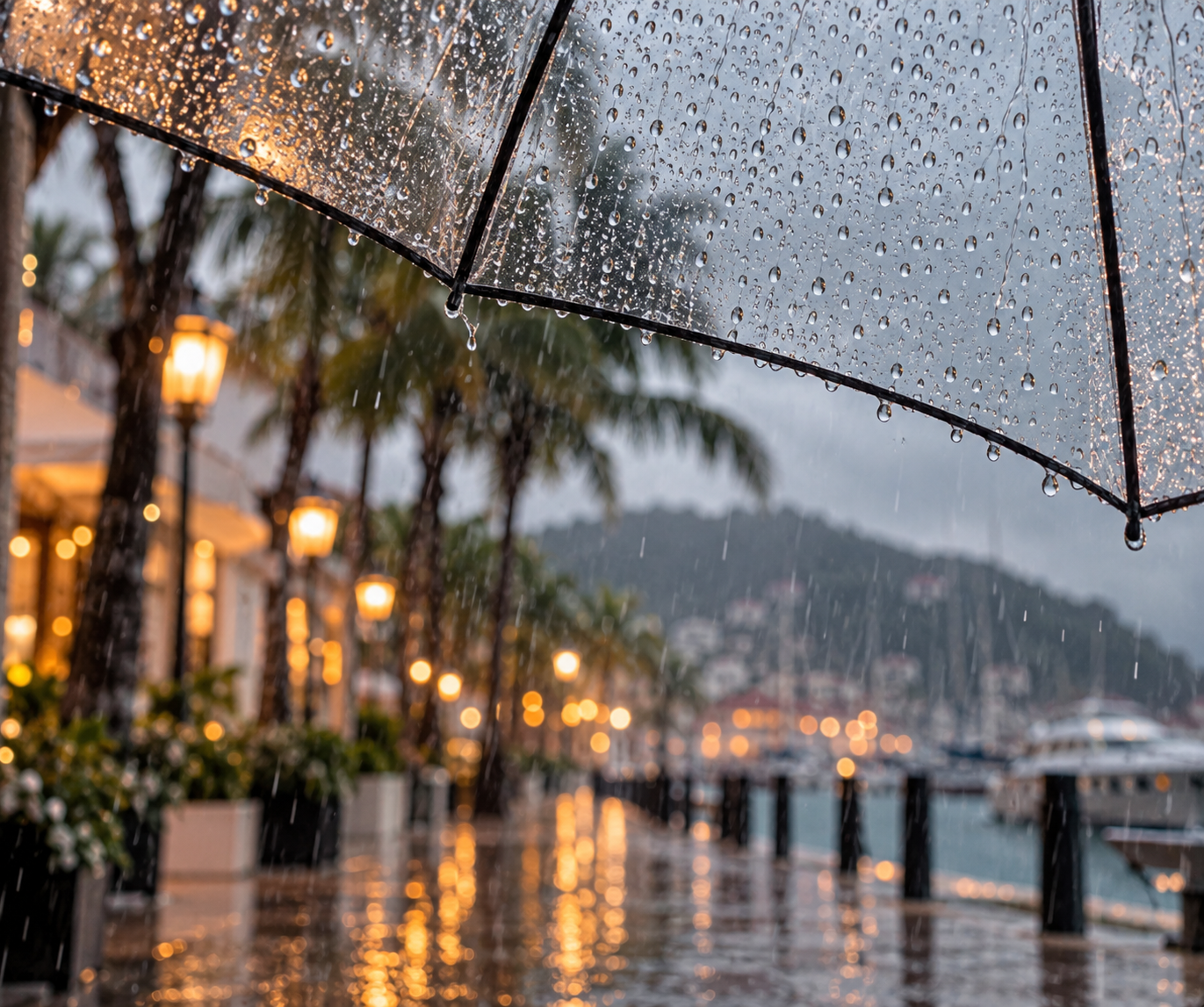
Some mornings the sea is too rough for a boat trip, the horizon has closed behind a grey veil, and the terrace is dripping quietly. In Saint-Barthélemy, it never lasts long. The rainy season — the hivernage — runs from May to November[3]; its showers are intense but brief, rarely more than an hour, and the sun is back with an almost irritating punctuality. On an island with annual rainfall around 900 mm[3] — less than many European cities — bad weather remains a parenthesis.
It is within these parentheses that some of the best discoveries happen. Those who live on the island know it: Saint-Barths, beyond its beaches and infinity pools, offers another way to be experienced — among its walls, ruined forts, workshops and dining rooms. Here are eight ways to spend a cloudy morning or afternoon without ever feeling like you are just waiting.
1. Wall House: stepping into the island's memory
A few steps from the Collectivité building, on the Pointe de Gustavia, the Wall House holds the territorial museum of Saint-Barthélemy[1]. The name says what it is: the only parts of the building to have survived the centuries are its stone walls, still standing while everything around them fell[1]. The structure has since been restored, and today it houses a collection that anchors the island's history.
The ground floor is dedicated to popular traditions: Barthesian costumes, fishing tools, everyday objects that tell the story of island families before tourism[1]. The municipal library occupies the upper floor. The museum also hosts temporary exhibitions by contemporary artists[1].
Admission is free[2]. The museum is easily accessible from any neighbourhood on the island, and a full visit takes between 45 minutes and an hour.
Indicative address: 2 rue de Pitea, La Pointe, Gustavia. Indicative hours: Monday–Friday 9:30–12:30 and 15:00–19:00, Saturday 9:30–13:00. [TO VERIFY: confirm hours directly with the museum or via the Office de Tourisme before your visit.]
2. Inter Oceans Museum, Corossol: a lifetime collection
Four kilometres from Gustavia, the village of Corossol has a different character from the rest of the island — colourful wooden boats beached on the sand, low houses, a quietness that belongs only to places that stayed outside the tourist circuit. It is here that Ingénu Magras, a native of Corossol, devoted a lifetime to assembling what is now one of the Caribbean's most remarkable shell collections: nearly 9,000 specimens from Japan, Australia, Hawaii, Africa and Latin America, organised and classified by family[3].
The museum is housed in the family home. The atmosphere is the opposite of an institutional museum — intimate, sometimes silent, with a quality that only collections built out of passion can convey. Samples of sand from seas around the world complete the display.
Admission: 3 EUR. [TO VERIFY: hours and opening status — private museum managed by the Magras family, unannounced closures are possible. Check locally or with the Office de Tourisme before making the trip.]
3. The forts of Gustavia: two centuries of history on the hillsides
Gustavia still carries, in its partly ruined forts, traces of the Swedish period (1784–1878) that shaped the island's identity. Two sites are reachable on foot from the harbour.
Fort Gustaf — built in 1787 in honour of King Gustav III[3] — overlooks the port from the north. The climb from Rue Schoelcher takes less than ten minutes. The view over the bay and the yachts at anchor is one of the most photographed on the island.
Fort Karl, on the hill that commands Gustavia from the south, has a slightly more recent history: built in 1789 to defend the town[5], named after Karl XIII (brother of Gustav III)[5]. Transferred to France's Conservatoire du littoral in 2007[5], the site underwent restoration that uncovered remains buried under the vegetation: an old powder magazine, paved stones, a wooden balustrade[5]. A botanical trail presents the plant species characteristic of the hillside[5]. The view takes in Shell Beach, Gustavia bay, and the small islands of Les Petits Saints.
Both forts are free to access[5]. In wet weather, the paths can be slippery — wear suitable footwear and, if possible, wait for a lull.
4. A spa treatment: the day you kept putting off
Rain may be the best reason to finally step through a spa door. Saint-Barths is home to several of the Caribbean's most discreet wellness spaces, each with its own signature.
The Cheval Blanc St-Barth Isle de France, in Flamands, is home to the only Guerlain spa in the Caribbean[3] — five treatment rooms, rituals that combine French haute parfumerie with Caribbean traditions. The Hotel Christopher, in Pointe Milou, offers Sisley treatments with a direct view over the Atlantic[4]. The Le Barthélemy Hotel & Spa, in Grand Cul-de-Sac, has developed its own concept in partnership with La Mer: hammam, sauna, Nordic baths, tearoom and targeted treatments[4].
Advance booking is recommended, especially during the high season. [TO VERIFY: access conditions for non-hotel guests — contact each property directly.]
If you are staying in a villa, our Saint-Barths concierge service can also arrange in-villa treatments with partner therapists.
5. Ligne St Barth in Lorient: forty years of an island brand
Founded in 1983 by Hervé Brin on Saint-Barthélemy, Ligne St Barth is one of those brands that started from a simple necessity and became, over the decades, an institution[3]. The first bottles of soap and shampoo were labelled by hand with a gold pen; today the range is distributed worldwide, yet remains anchored on the island.
The workshop and main boutique are in Lorient, on the route de Saline — the village described as the island's first French colonial settlement[3]. A second boutique is open in Gustavia, on Rue du Général de Gaulle, near the port[3]. The ingredients remain natural: roucou oil, aloe vera gel, avocado oil, papaya.
Stopping there on a rainy morning is a way to understand what is actually made on the island. [TO VERIFY: availability and conditions for workshop visits — ask directly at the Lorient boutique.]
6. Duty-free shopping in Gustavia
Saint-Barthélemy has been a free port since the Swedish era — a status that translates directly into prices in Gustavia's boutiques, particularly for perfumes, jewellery, watches and certain imported spirits[3]. [TO VERIFY: the exact categories of exempt products and current customs arrangements may change — check comstbarth.fr for up-to-date regulations.]
Rue de la République and Rue du Roi Oscar II are home to the major luxury names: Hermès, Louis Vuitton, Cartier, Bulgari, Chopard, Dolce & Gabbana, Ralph Lauren. The boutiques generally remain open in overcast weather. A rainy morning often means easier browsing than a high-season Tuesday afternoon in the sun.
For a fuller picture of Gustavia, see our complete guide to Gustavia.
7. A long lunch: the table as destination
When the beach is not an option, the table becomes one. Saint-Barths has restaurants whose reputation alone justifies the outing — beach venues with covered terraces, carefully designed interiors in Gustavia or Saint-Jean, quiet addresses discovered by word of mouth.
Our concierge team maintains relationships with the island's best-placed tables and can secure a reservation even at peak times of the season.
8. Private chef in the villa: staying in, and eating well
The simplest answer to a cloudy day is sometimes not to go out at all — and to make the villa the centre of the day.
A private chef can be arranged the evening before, or in many cases on the morning itself: they bring ingredients sourced from the local market, prepare the meal in your kitchen, and serve at your covered terrace table or indoor dining room. The chefs partnered with Sun Beach House work with seasonal produce and adapt menus to your preferences and dietary requirements.
It may be the one circumstance on Saint-Barths where a little rain is welcome news. For more information, read our dedicated article on private chefs in villas, or reach out to our concierge service.
Frequently asked questions
When does it rain in Saint-Barths? The hivernage — the rainy season — runs from May to November[3]. Showers are typically intense but brief, rarely lasting more than an hour or two. September and October are the wettest months. During the high season (December–April), rainy days are uncommon.
Are the museums open year-round? The Wall House and Fort Karl are accessible throughout the year[1][5]. The Inter Oceans Museum is privately managed by the Magras family — unexpected closures are possible. [TO VERIFY: check locally before making the trip.]
Can a private chef be arranged at short notice? In most cases, yes — with a few hours' notice, our concierge team can arrange a chef for lunch or dinner. During the high season, 24 hours' notice is preferable.
Is Gustavia really duty-free? Saint-Barthélemy has a special customs arrangement inherited from the Swedish period, which generally results in prices lower than mainland France for certain imported goods[3]. [TO VERIFY: exact categories depend on current regulations — see comstbarth.fr.]
Are hotel spas open to non-guests? Most of the island's major establishments accept outside visitors on a reservation basis, subject to availability[4]. Our concierge service can check availability and make the booking on your behalf.
Our recommendation
A rainy day in Saint-Barths is not a setback — it is an invitation to discover the island differently. Its museums, forts, boutiques, workshops, spas and dining rooms make up a complete programme that stands on its own terms.
If you would like every day of your stay to be thought through in advance — including the unpredictable ones — our Saint-Barths concierge service is there to anticipate each scenario and offer the best option, whatever the weather. To find the right villa for your stay, browse our selection of villas in Saint-Barths.
- Saint Barth Tourisme — Territorial Museum Wall House — https://www.saintbarth-tourisme.com/en/territorial-museum-wall-house/ — accessed 20/07/2026 ↩
- Collectivité de Saint-Barthélemy — Service Musée et traditions populaires — https://www.comstbarth.fr/services-en-ligne/service-musee-et-traditions-populaires — accessed 20/07/2026 ↩
- AFAR Magazine — Saint-Barthélemy Travel Guide — https://www.afar.com/travel-guides/saint-barthelemy/guide — accessed 20/07/2026 ↩
- Forbes Travel Guide — Le Barthélemy Hotel & Spa — https://www.forbestravelguide.com/hotels/st-barts-st-barts/le-barthelemy-hotel-spa — accessed 20/07/2026 ↩
- Conservatoire du littoral — Fort Karl — https://www.conservatoire-du-littoral.fr/siteLittoral/604/28-fort-karl-977_saint-barthelemy.htm — accessed 20/07/2026 ↩