Saint-Barthélemy Tax Status: What It Means for Property Buyers
No property tax, no VAT, 5% registration fees: a clear guide to Saint-Barthélemy's autonomous tax regime for real estate buyers.
By Sun Beach House
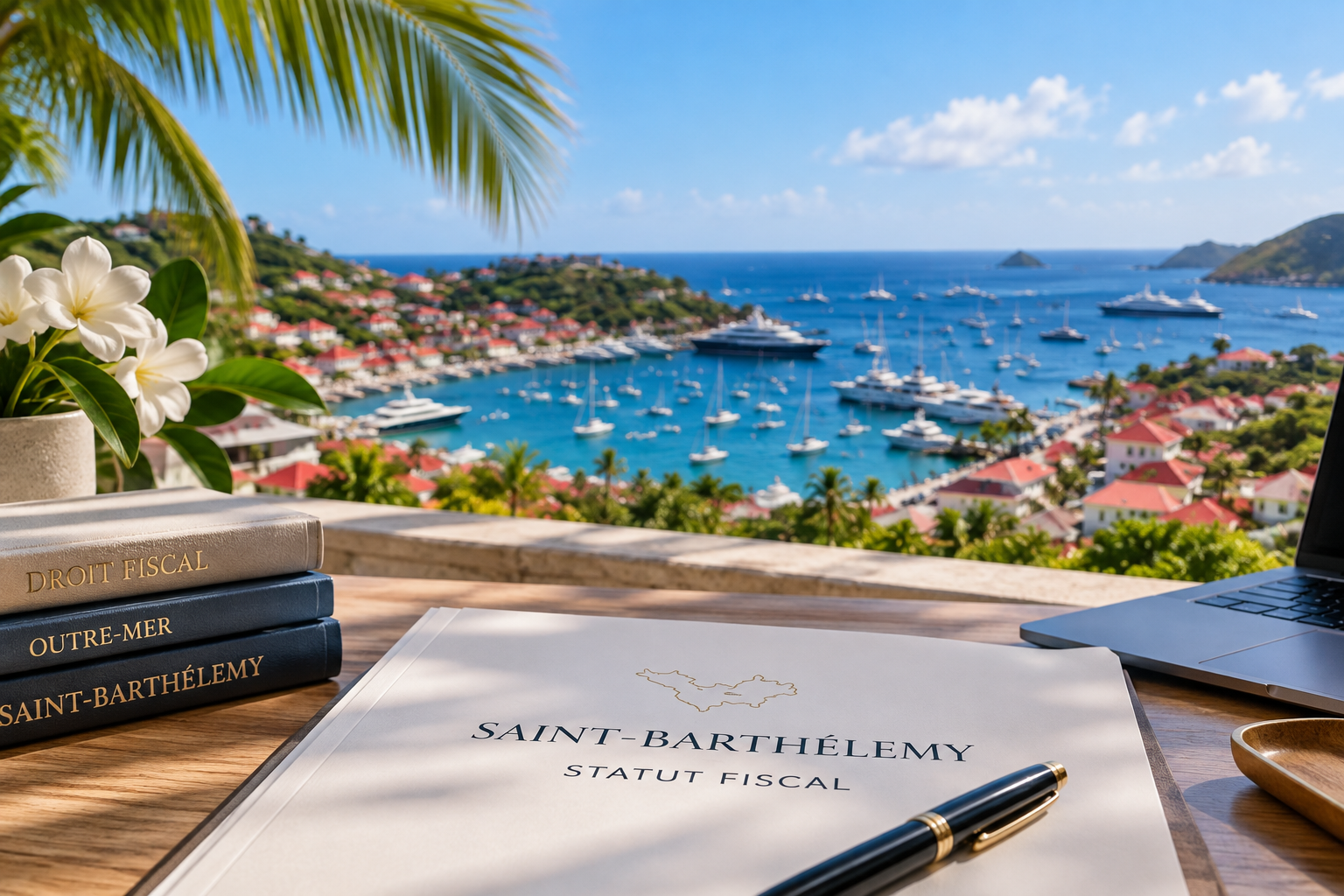
In the Caribbean, some islands attract buyers with scenery alone. Saint-Barthélemy attracts them with scenery and something else: a fiscal status that sets it apart from every other French territory. Since 2007, the island has operated under its own tax code — independent from French tax law — making it one of the most singular property markets in the world for any buyer to understand.
This article does not provide personalized tax advice. Every buyer's situation is different, and a notary or specialized tax advisor should be consulted before any purchase or decision to establish tax residence. What follows is a factual explanation of how the local tax regime works and what it means concretely for a property buyer.
An autonomous territory since 2007
Organic Law n° 2007-223 of 21 February 2007 transformed Saint-Barthélemy into an overseas collectivity (COM) governed by Article 74 of the French Constitution[3]. What had been a commune of Guadeloupe became an autonomous territory with its own legislative powers, including full autonomy in tax matters.
The collectivity has its own Code des Contributions — a local tax code voted and updated by the island's Territorial Council[4]. This code, not the French General Tax Code, governs local taxation: registration duty rates, local income tax, capital gains, and inheritance.
Two immediate consequences for any buyer:
No VAT. Saint-Barthélemy falls outside France's VAT territory. France's General Customs and Indirect Duties Directorate confirms that French VAT does not apply to transactions on the island, and the Collectivity does not levy a local VAT either[5].
No transfer duties to the French state. Registration fees paid on a property sale go entirely to the Collectivity — not to Paris — at rates set by local law.
What you pay at the time of purchase
Regardless of your nationality, country of residence, or personal tax status, two cost items apply to every property acquisition in Saint-Barthélemy.
Registration duties: 5%
The Code des Contributions sets the registration duty at 5% of the property's declared value[4]. This is the local equivalent of France's transfer duty (DMTO), but collected entirely by the Collectivity.
In practice: if you buy a villa declared at €3 million, you pay €150,000 in registration duties.
Total acquisition cost: 6% to 7%
Add notary fees and land registry costs to the registration duty, and total acquisition costs run between 6% and 7% of the purchase price[6]. The buyer traditionally bears these costs.
| Item | Approximate rate |
|---|---|
| Registration duties | 5.00% |
| Notary fees + disbursements | ~1.00–1.50% |
| Land registry inscription | ~0.10% |
| Total | ~6.10–6.60% |
These rates are lower than in metropolitan France, where transfer duties alone reach around 5.80% before notary fees, bringing the total to 7–8%.
No recurring taxes on ownership
One of the most concrete aspects of Saint-Barthélemy's fiscal status is the absence of annual property holding taxes.
No property tax (taxe foncière)
The property tax on built properties — a significant annual cost for any owner in metropolitan France — is not collected in Saint-Barthélemy. The Collectivity has set its rate at 0%[7]. A villa owner pays nothing annually simply for holding the property.
No wealth tax
The French Impôt sur la Fortune Immobilière (IFI), which applies in France on net real estate assets above €1.3 million, does not exist in Saint-Barthélemy in this form[6]. The Collectivity does not levy an equivalent tax on wealth.
These two absences fundamentally change the long-term economics of property ownership compared to metropolitan France.
The 5-year threshold: advantages for fiscal residents
The advantages most often cited — no income tax, no wealth tax, no inheritance tax — do not automatically apply to every buyer. They are reserved for those who have established genuine fiscal domicile on the island for at least five years.
Conditions for fiscal residency in Saint-Barthélemy
Article LO6214-4 of the General Code of Territorial Collectivities specifies that a natural person can only be considered to have their fiscal domicile in Saint-Barthélemy after residing there for at least five years[3]. Three alternative criteria apply:
- Their home (principal residence) is on the island; or
- Their main place of residence is on the island; or
- Their center of economic interests is established there.
Buying a villa and renting it out seasonally is not enough. The buyer must sever — or never have — their principal fiscal domicile in France or elsewhere, and establish a real, continuous presence on the island.
French tax authorities may challenge fiscal domicile declarations they consider artificial. Professional advice from a notary or tax attorney is essential before any move motivated by fiscal residency.
What a fiscal resident with 5+ years on the island gains
Subject to meeting the residency conditions, a Saint-Barthélemy fiscal domiciliary benefits from:
- No income tax on income sourced in Saint-Barthélemy, including rental income from properties on the island[2][6].
- No wealth tax (IFI equivalent) on real estate assets located in Saint-Barthélemy[6].
- No inheritance or gift tax on assets located on the island, subject to applicable allowances under the Code des Contributions[2].
What fiscal residence in Saint-Barthélemy does not eliminate
French social charges (CSG, CRDS, mandatory contributions) fall under the exclusive competence of the French state, not the Collectivity. They may continue to apply depending on individual circumstances[2].
For foreign-source income (dividends, income from assets in other countries, pensions from French companies), the Code des Contributions may not be the only applicable regime — bilateral tax treaties and French rules may also apply.
Capital gains tax: the one tax that applies to everyone
Whether you are a resident or not, French or foreign, there is a capital gains tax in Saint-Barthélemy on real estate sales.
Rates and mechanism
The Code des Contributions provides the following schedule[8]:
| Holding period | Capital gains rate |
|---|---|
| Under 8 years | 35% of net gain |
| From year 9 onwards | 20% |
| Years 9 to 18 | 20% minus 10% per year held |
| After ~18 years | Full exemption |
For a property held 13 years, the taxable gain is halved. After 18 years of ownership, the gain is fully exempt from local capital gains tax[7][8].
This structure was tightened in 2017 when the Collectivity raised the rate for short-term sales to 35%, with the stated purpose of curbing real estate speculation on a structurally scarce market[8].
Primary residence: a specific regime
Primary residences are treated differently under the Code des Contributions, with an accelerated abatement schedule. The precise terms should be verified with a local notary before any decision[4].
No French social levies on capital gains
Unlike in metropolitan France, gains realized on property sales in Saint-Barthélemy are not subject to French social levies (17.2% in metropolitan France)[5]. Taxation stops at the local capital gains tax.
Frequently asked questions
Can a foreign national buy property freely in Saint-Barthélemy?
Yes. There are no nationality-based restrictions on property purchases in Saint-Barthélemy. American, British, and non-EU nationals have exactly the same acquisition rights as French citizens[6].
Does the buyer need to live in Saint-Barthélemy to avoid income tax on rental proceeds?
Yes. The income tax exemption — including on rental income — is reserved for fiscal residents domiciled in Saint-Barthélemy for more than five years under Article LO6214-4 conditions[3]. A non-resident owner who rents out their villa remains subject to their personal tax regime.
Is there a local tax on short-term rental income?
The Collectivity collects a taxe de séjour (tourist tax) on tourist accommodations[4]. This is a tax on occupants — collected by the owner or booking platform at reservation — not an income tax on the property owner.
What is the difference between buying a villa and becoming a fiscal resident in Saint-Barthélemy?
Property acquisition and fiscal residency are two independent statuses. You can buy a villa in Saint-Barthélemy while remaining a French fiscal resident — in which case you pay taxes in France. Only genuine, durable fiscal domicile on the island (five years or more) opens access to the benefits of the local Code des Contributions.
Is Saint-Barthélemy's fiscal status permanent?
The current regime is founded on an organic law (2007) and a constitutional provision (Article 74). Any significant modification to the Collectivity's status would require legislation of equivalent rank. The framework is relatively stable, but no perpetual guarantee exists in law.
Our recommendation
Saint-Barthélemy's fiscal regime offers real advantages for a property buyer — particularly no property tax, no VAT on acquisition, and the prospect of complete capital gains exemption after eighteen years of ownership. For those planning to settle permanently, the fiscal residency benefits can represent a substantial saving on a high-value estate.
But this regime involves precise conditions, a complex hierarchy of legal texts, and interactions with international tax law that only a specialized advisor can properly assess for your situation.
To understand the purchase process in detail (notary, registration, financing), our article on buying a villa in Saint-Barthélemy is a useful companion. To browse available properties, explore our villa sales portfolio. Our team can also connect you with local professionals — notaries and chartered accountants — who regularly handle these files. Contact Valérie to start the conversation.
- Saint Barts Real Estate Market Guide 2026 — Cyril Jarnias — https://www.jarniascyril.com/international-real-estate/invest-in-real-estate-saint-barthelemy-guide-marche-premium/ — accessed 18/08/2026 ↩
- La fiscalité applicable aux résidents de la Collectivité d'Outre-Mer de Saint-Barthélemy — MonExpertComptablePrivé.fr — https://monexpertcomptableprive.fr/2023/11/24/la-fiscalite-applicable-aux-residents-de-la-collectivite-doutre-mer-de-saint-barthelemy/ — accessed 18/08/2026 ↩
- Organic Law n° 2007-223, 21 February 2007 / Article LO6214-4 — Légifrance — https://www.legifrance.gouv.fr/loda/id/JORFTEXT000000465963 — accessed 18/08/2026 ↩
- Code des Contributions de Saint-Barthélemy (Délibération CT 2024_038) — Collectivité de Saint-Barthélemy — https://www.comstbarth.fr/ — accessed 18/08/2026 ↩
- Cas particuliers de l'île de Saint-Barthélemy — Direction Générale des Douanes et Droits Indirects — https://www.douane.gouv.fr/fiche/cas-particuliers-de-lile-de-saint-martin-et-de-lile-de-saint-barthelemy — accessed 18/08/2026 ↩
- Understanding St. Barts Property Taxes and Fees — WIMCO Real Estate — https://wimcorealestate.com/en/blog/understanding-st-barts-property-taxes-and-fees-a-guide-for-foreign-buyers — accessed 18/08/2026 ↩
- Market Update St Barths September 2023 — Roche Realty — https://www.roche-realty.com/market-update-st-barths-september-2023 — accessed 18/08/2026 ↩
- Saint-Barth increases its tax on real estate gains to stop speculation — Batinfo — https://batinfo.com/en/actuality/saint-barth-increases-its-tax-on-real-estate-gains-to-stop-speculation_7749 — accessed 18/08/2026 ↩