Buying a Villa in Saint-Barthélemy: Process, Notary, Financing
Notary, registration duties, local taxation, planning rules: the sourced guide to buying a villa in Saint-Barthélemy.
By Sun Beach House
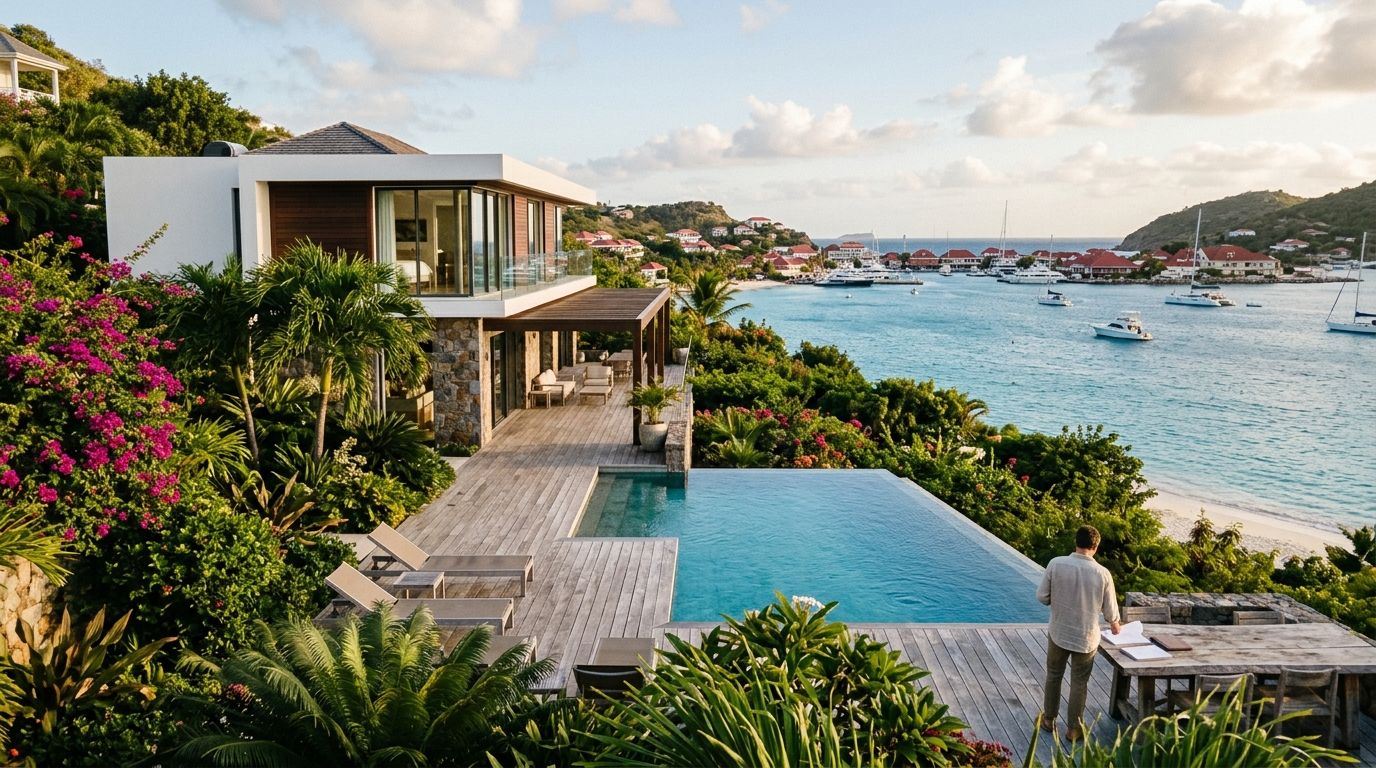
On the port of Gustavia, a notarial office receives buyers from around the world all year round — the island has its own local notary practice, affiliated with the Chamber of Notaries of Guadeloupe, Saint-Barthélemy and Saint-Martin[8]. This professional, and this professional alone, will authenticate your deed of sale. Buying a villa in Saint-Barthélemy follows a precise legal framework: French civil law, applied on a territory that, since 2007, manages its own taxation[1]. Understanding this distinction before committing lets you approach each step of the acquisition process with a clear head.
Saint-Barthélemy: French territory, autonomous taxation
Saint-Barthélemy is not a standard overseas department. The organic law of February 21, 2007 established the island as an overseas collectivity with autonomy, under article 74 of the French Constitution[1]. Concretely, the General Code of Territorial Collectivities, in its section on Saint-Barthélemy, grants the Collectivity the authority to set its own tax rules, subject to the general principles of French tax legislation[1].
This autonomy takes the form of a Code of Contributions specific to the island, distinct from the metropolitan French tax code, and regularly updated by deliberation of the Territorial Council[2]. The French administration itself acknowledges this particular status: the Directorate General of Customs and Indirect Taxes dedicates a specific information sheet to the "special cases" of Saint-Martin and Saint-Barthélemy within French tax territory[3].
For a buyer, this dual reality is essential to keep in mind: the civil law framework (property, contracts, real estate transactions) remains that of France, while the tax framework (registration duties, resident status) is specific to the Collectivity. Neither dimension should be confused with the other when building your acquisition project.
The notary's role, from the preliminary agreement to the final deed
As everywhere in France, no real estate sale can be concluded without going through a notary, the public officer responsible for authenticating the transaction[7]. The process follows the same broad steps as an acquisition in mainland France:
- The preliminary sales agreement (compromis or promesse de vente), which sets out the terms of the transaction (price, description of the property, conditions precedent such as obtaining financing)[7].
- A withdrawal period for the buyer, followed by the progressive fulfillment of the conditions precedent.
- The final deed (acte authentique), signed before the notary, which officially transfers ownership.
The usual period between signing the preliminary agreement and the final deed is generally two to three months, time needed to gather the file's documents and clear the conditions precedent; this period can vary depending on the complexity of each transaction[7].
In Saint-Barthélemy, this process comes with a practical reality: the island has a notarial office based locally, and the Chamber of Notaries of Guadeloupe, Saint-Barthélemy and Saint-Martin holds regular on-site sessions reported by the local press[6][8]. For a buyer who does not live on the island year-round, it is advisable to contact the notarial office well ahead of the project, in order to anticipate the file preparation — identification documents, proof of financing, and, if a physical presence at signing is not possible, a power of attorney.
What to anticipate regarding the taxation of the acquisition
This is the point that calls for the most caution, and on which no personalized advice can replace that of a notary or an accountant familiar with your specific situation.
Registration duties. Every real estate acquisition in Saint-Barthélemy triggers the payment of registration duties collected by the Collectivity, with the Code of Contributions setting the rate at 5% of the declared value of the property[2][9]. Adding the notary's fees and the ancillary costs related to the registration formality, the total cost borne by the buyer generally falls in a range of around 6 to 7% of the sale price[2][9] — an amount your notary will calculate precisely when preparing your file, as these scales can change.
No property tax or housing tax. Under the Collectivity's own tax regime, residents whose tax domicile is established in Saint-Barthélemy are not subject to property tax (taxe foncière) or housing tax (taxe d'habitation), unlike the regime that applies in mainland France[2][9]. This point should nevertheless be verified case by case: tax residency status in Saint-Barthélemy follows specific criteria, and a non-resident owner generally retains tax obligations in their country of tax residence. Only a tax advisor familiar with your personal situation can confirm which regime applies to you.
Capital gains on resale. The Code of Contributions also provides for a capital gains regime, with a progressive allowance mechanism tied to the length of time the property is held[2]. Rather than putting forward a detailed scale that varies according to the nature and use of the property, we recommend addressing this point directly with your notary at the time of purchase: based on the Code of Contributions in force, they can indicate the regime applicable to your future resale plans.
In every case, these three dimensions — registration duties, holding taxation, and resale taxation — should be verified with your notary and, for any question relating to your personal situation, with a qualified tax advisor. No serious professional will commit to a final figure before reviewing your file.
Scarce land, shaped by strict planning rules
The scarcity of properties available in Saint-Barthélemy is not just marketing language: it rests on a structurally restrictive planning framework. In December 2020, the Territorial Council adopted a new zoning map that revised building height rules and restricted construction on certain beaches, while opening new building rights in around fifteen sectors of the island[4].
This regulation continues to evolve: in February 2024, a public meeting bringing together nearly two hundred people allowed the Collectivity's leadership to address the clarifications still needed on planning matters[5]. For a buyer, the practical consequence is twofold: on one hand, buildable land remains inherently limited on a small island; on the other, any renovation, extension, or construction project must be checked beforehand with the Collectivity's planning department and your notary, to confirm the rights attached to the parcel in question.
Financing your acquisition: what the file involves
Financing is one of the standard conditions precedent built into the preliminary sales agreement: if the buyer indicates they will use a loan, the sale is made conditional on obtaining it, within a period specified in the contract[7]. The notary, working with your bank, oversees this step of the file.
We do not currently have sufficiently reliable and sourced market data to indicate a breakdown between financed transactions and cash transactions in Saint-Barthélemy: this topic is best discussed directly with your notary and your banking advisor, who can guide you according to your profile and the type of property targeted.
What we can recommend, however, is preparing the financing file as early as possible in the process: proof of the source of funds, a bank's agreement in principle if financing is planned, and, for a buyer unable to travel for every step, a power of attorney prepared with the notary. This preparation helps keep to the usual two-to-three-month period between the preliminary agreement and the final deed[7].
Frequently asked questions
Can a foreign buyer purchase a villa in Saint-Barthélemy? The transaction follows French civil law, overseen by a notary, as for any real estate sale on the territory[1][7]. The practical arrangements specific to a buyer residing abroad — documents required, possible power of attorney — should be confirmed directly with the notarial office handling the file.
How long does the process take, from offer to final signature? The usual period between signing the preliminary agreement and the final deed is around two to three months, a timeframe that can vary depending on the complexity of the file and the fulfillment of conditions precedent[7].
Do you have to pay property tax on a villa in Saint-Barthélemy? Residents whose tax domicile is established in Saint-Barthélemy are exempt under the Collectivity's own regime[2][9]. This point, however, depends on the buyer's tax residency status and should be confirmed with a tax advisor.
What costs are added to the listed sale price? Registration duties of around 5% of the declared value of the property are collected by the Collectivity, bringing the total cost of the acquisition generally to around 6 to 7% of the price, notary fees included[2][9] — an amount to have confirmed precisely by your notary.
Why are so few villas available for sale? The local planning framework — regulated building heights, restrictions on certain beaches — structurally limits the supply of buildable land on a small island[4][5].
Our recommendation
Buying a villa in Saint-Barthélemy means surrounding yourself, from the very first steps, with a notary and, where relevant, a tax advisor familiar with the Collectivity's specificities. Sun Beach House has supported owners and buyers on the island since 1996: we know the neighborhoods, their planning rules and their particularities, and can point you toward our selection of villas for sale in Saint-Barthélemy for an initial look at the market. If your project includes a seasonal rental dimension, our selection of villas for rent in St Barth gives a concrete sense of what is possible. Once you own a property, our concierge team on the island remains available for the upkeep and management of your home between stays. To get to know the island's neighborhoods before deciding, our guide to Gustavia, the historic and administrative heart of Saint-Barthélemy is a good starting point, as is the page dedicated to Valérie Kerckhofs, founder of Sun Beach House, on the island since 1996.
Sources
- Légifrance — General Code of Territorial Collectivities, Book II Saint-Barthélemy (articles LO6211-1 to LO6271-8) — https://www.legifrance.gouv.fr/codes/section_lc/LEGITEXT000006070633/LEGISCTA000006135517/ — accessed August 7, 2026 ↩
- Collectivité de Saint-Barthélemy — Code des contributions de Saint-Barthélemy, annex to Territorial Council deliberation No. 2024_038CT — https://actes.eservices-comstbarth.fr/PJ/Deliberation%20CT/Deliberation%20CT_2024/2024_038ct_annexe.pdf — accessed August 7, 2026 ↩
- French Directorate General of Customs and Indirect Taxes — Special cases of the island of Saint-Martin and the island of Saint-Barthélemy — https://www.douane.gouv.fr/fiche/cas-particuliers-de-lile-de-saint-martin-et-de-lile-de-saint-barthelemy — accessed August 7, 2026 ↩
- Le Journal de Saint-Barth — The new zoning map adopted — https://www.journaldesaintbarth.com/fr/actualites/urbanisme/la-nouvelle-carte-durbanisme-adoptee-202012082045.html — accessed August 7, 2026 ↩
- Le Journal de Saint-Barth — Planning: regulations still needing clarification — https://www.journaldesaintbarth.com/fr/actualites/urbanisme/urbanisme-une-reglementation-qui-reste-a-eclaircir-202402231625.html — accessed August 7, 2026 ↩
- Le Journal de Saint-Barth — Real estate (news and Chamber of Notaries on-site sessions) — https://www.journaldesaintbarth.com/search/immobilier.html — accessed August 7, 2026 ↩
- Immobilier.notaires.fr (Conseil supérieur du notariat) — Preliminary sales agreement: timeframes, conditions — https://www.immobilier.notaires.fr/fr/articles/conseils-et-actualites/achat-vente/compromis-de-vente-promesse-de-vente-delais-conditions — accessed August 7, 2026 ↩
- Ricour-Brunier — Notarial office of Saint-Barthélemy and Saint-Martin — https://ricourbrunier.notaires.fr/etude-notariale-st-barthelemy-st-martin.html — accessed August 7, 2026 ↩
- Quante — Taxation applicable to residents of the overseas collectivity of Saint-Barthélemy — https://www.quante.fr/insight/la-fiscalite-applicable-aux-residents-de-la-collectivite-doutre-mer-de-saint-barthelemy/ — accessed August 7, 2026 ↩