Fête de Saint-Barthélemy and Saint-Louis: two days of tradition (August 24-25)
On August 24-25, Saint-Barthélemy celebrates its patron saint festivals in Gustavia and Corossol: mass, procession, living tradition.
By Sun Beach House
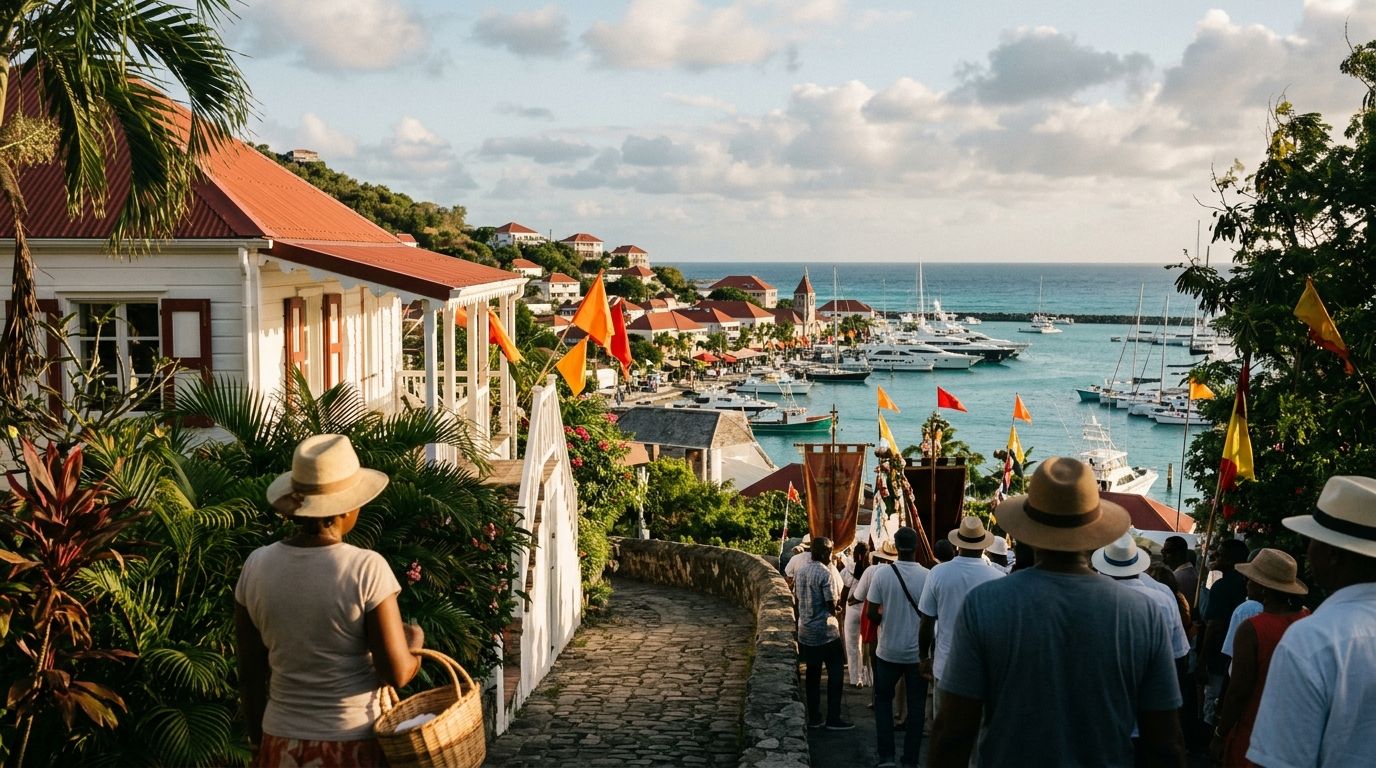
It is 8:30 am on August 24, and the sailors' mass begins at the church of Notre Dame de l'Assomption, in the heart of Gustavia[1][5]. Twenty-four hours later, at dawn on the 25th, the fishing boats of Corossol leave the beach for the traditional morning fishing competition[2]. Between these two moments, the island lives through its most intimate weekend of the year: the two patron saint festivals, the Fête de Saint-Barthélemy in Gustavia and the Fête de Saint-Louis in Corossol.
For a visitor staying in a villa in late August, this weekend offers something high season does not: the chance to witness, as a respectful guest, an island celebrating its own calendar rather than that of its visitors.
Two festivals, one weekend
The Fête de Saint-Barthélemy, celebrated on August 24, commemorates the island's own patron saint. It takes place in Gustavia, around the harbor and the Collectivité square, combining an official part (mass, wreath-laying, speeches) with a festive one (games, entertainment, a ball, fireworks)[1][5].
The next day, August 25, it is Corossol's turn to honor its patron saint: Saint Louis, venerated here as the protector of fishermen[6]. The day opens at dawn with a fishing competition and continues with a mass, a procession, and then a series of traditional games and dances[2][6].
These two celebrations fall in the same week by religious tradition rather than administrative coincidence: each honors the saint whose name was given, respectively, to the island itself and to the village of Corossol. The survival of these Catholic ceremonies is worth noting given that Saint-Barthélemy belonged to Lutheran Sweden from 1784 to 1878: the Swedes practiced their own faith, while the local population remained faithful to its own church[4]. This religious continuity through the Swedish period helps explain why mass and procession still open each patronal festival today.
This religious identity is rooted in an eventful history. The island was settled by Norman and Breton sailors from 1763 onward, before France ceded it to the Sweden of King Gustav III in 1784[9]. It remained under Swedish administration until its retrocession to France, sealed by a treaty signed in Paris on August 10, 1877 and ratified the following year[9][10]. Despite this near-century-long Swedish interlude, the Catholic customs inherited from the first Norman and Breton settlers never disappeared — a continuity still visible today in the way both patronal festivals unfold on August 24 and 25.
August 24 in Gustavia: from the sailors' mass to the fireworks
The day's structure follows a pattern established over successive editions, documented by the local press and the tourism office.
The morning opens at 8:30 am with the sailors' mass at the church of Notre Dame de l'Assomption, followed by a procession through the streets of town[1][5]. At 10:30 am, wreaths are laid at the foot of the war memorial, before officials gather for the customary speeches[1][5].
The afternoon then shifts into festive mode. Depending on the year, this has included a belote card tournament, games and entertainment organized by local associations — the association Island Vibes took charge of this in 2025[1] — and, in some years, an archery introduction[5]. In earlier editions, the harbor quay also hosted a late-afternoon dominoes tournament and a small regatta in the bay[3]. Neither of these last two featured on the 2025 program[1], a reminder of a simple reality: the exact content varies each year, and the detailed 2026 program is traditionally announced by the Collectivité territoriale in the days leading up to August 24.
The evening closes with music and dancing, a public ball, and, at a time set by the Collectivité, fireworks over the harbor[1][3][5].
August 25 in Corossol: the dawn fishing competition and the Fête de Saint-Louis
In Corossol, the day begins well before Gustavia's. From 6 am, fishermen register on the beach for the fishing competition, for a modest fee per boat[2]. This maritime tradition is more than folklore: Saint Louis is venerated here as the patron saint of fishermen, and the village has kept this celebration alive for more than fifty-five years, according to the Saint-Barthélemy tourism office[6].
The morning continues with a mass celebrated at the foot of the Saint-Louis rock, honoring the village elders, followed by a procession[2][6]. The rest of the day unfolds through a sequence of traditional games typical of Caribbean village festivals: a belote tournament, foosball, children's games, then, in the afternoon, a palets competition, darts and cornhole[2]. Food sales begin around midday, fishing competition prizes are awarded in the late afternoon, and the evening closes with a traditional dance performance[2].
Corossol, a village of weavers: latanier before the festival
No account of the Fête de Saint-Louis would be complete without mentioning what makes Corossol distinct on the island. It is a traditional fishing village, one of the few places in Saint-Barthélemy where artisans can still be seen weaving latanier straw into hats, bags and everyday objects — a craft passed down from generation to generation[6].
Its brown-sand beach, different from the white sand found elsewhere on the island, shelters the dories, traditional fishing boats found nowhere else on Saint-Barthélemy[6]. It is in this very bay that, every August 25 at dawn, the fishing competition boats set out.
This setting gives the Fête de Saint-Louis a different tone from Gustavia's: more village-like, more rooted in the fishing and craft traditions that have shaped Corossol's identity for generations. For a visitor, walking through the village in the days before August 25, as preparations begin, offers a picture of Saint-Barthélemy that the postcard view of Gustavia's harbor does not.
Why late August remains the most authentic time to stay in a villa
Late August falls squarely within Saint-Barthélemy's low tourist season, which generally runs from May to October, with partial closures of some restaurants and businesses between July and October[7]. In practical terms, that means a quieter island, tables that are easier to book, and rental rates that are generally more accessible than in December or March.
This calm is not a meteorological coincidence: the official hurricane season for Guadeloupe, Saint-Martin and Saint-Barthélemy runs from June to November[8]. Staying in late August means keeping an eye on the weather forecast in the weeks before departure — a simple precaution, and one that does not change the fact that most seasons pass without incident. It is precisely this combination — a quieter island, a social calendar centered on its residents rather than its visitors — that makes this August 24-25 weekend particularly worthwhile for anyone trying to understand Saint-Barthélemy beyond its beaches.
To learn more about Gustavia before or after the festival, our Gustavia guide covers the harbor's history, its shops and its addresses. For those who want to stay close to Corossol, the Corossol neighborhood remains one of the island's most preserved areas, and our destinations page presents all of Saint-Barthélemy's neighborhoods.
Frequently asked questions
What is the difference between the Fête de Saint-Barthélemy and the Fête de Saint-Louis? The Fête de Saint-Barthélemy, on August 24 in Gustavia, celebrates the patron saint of the entire island. The Fête de Saint-Louis, the following day in Corossol, celebrates the patron saint of fishermen and remains centered on that village and its maritime tradition[1][2][6].
Where does the Fête de Saint-Barthélemy take place on August 24? It takes place in Gustavia, with mass at the church of Notre Dame de l'Assomption, the ceremony at the war memorial, and entertainment organized around the harbor[1][5].
Is the 2026 program already published? No. As of this article's writing (early August 2026), the detailed 2026 program has not yet been published. The Collectivité territoriale traditionally announces exact times in the days leading up to August 24. The schedule described here draws on the 2019, 2024 and 2025 editions, as documented by the local press and the tourism office[1][2][3][5].
Can visitors watch the Corossol fishing competition? Yes, the Fête de Saint-Louis is a village festival open to everyone, with food sales, games and entertainment accessible to the public throughout the day[2].
Is late August a good time to rent a villa in St Barths? It is a low-season period, generally quieter and more accessible price-wise than the high-season months, though some businesses close for renovation or holidays between July and October — worth checking case by case before booking a specific restaurant. The main precaution remains weather-related, since the official hurricane season runs through November[7][8].
Our recommendation
If you are considering a late-August stay, this August 24-25 weekend deserves to be placed at the center of your calendar rather than treated as just another day: it is one of the rare moments when Saint-Barthélemy shows itself as it is outside the tourist season. Our team knows the Gustavia and Corossol neighborhoods and can point you toward a villa well positioned to enjoy both days without unnecessary travel. Browse our selection of villas available in late August, and our concierge service to arrange transfers and reservations around the festival schedule.
- Le Journal de Saint-Barth — "Fête de la Saint-Barthélemy: entre cérémonies officielles et festivités" — https://www.journaldesaintbarth.com/actualites/culture-loisirs/fete-de-la-saint-barthelemy-entre-ceremonies-officielles-et-festivites-202508141504.html — published August 14, 2025 — accessed August 4, 2026 ↩
- Le Journal de Saint-Barth — "La fête de la Saint-Louis à Corossol" — https://www.journaldesaintbarth.com/actualites/vie-locale/la-fete-de-la-saint-louis-a-corossol-202408221853.html — published August 22, 2024 — accessed August 4, 2026 ↩
- Le Journal de Saint-Barth — "Saint-Barthélemy et Saint-Louis, les immanquables" — https://www.journaldesaintbarth.com/actualites/culture-loisirs/saint-barthelemy-et-saint-louis-les-immanquables-201908151429.html — published August 15, 2019 — accessed August 4, 2026 ↩
- Le Journal de Saint-Barth — "Et si Saint-Barth était restée suédoise?" — https://www.journaldesaintbarth.com/actualites/culture-loisirs/et-si-saint-barth-etait-restee-suedoise--201811011328.html — published November 1, 2018 — accessed August 4, 2026 ↩
- Saint Barth Tourisme (official tourism office) — "Feast of Saint-Barthelemy" — https://www.saintbarth-tourisme.com/en/feast-of-saint-barthelemy/ — accessed August 4, 2026 ↩
- Saint Barth Tourisme (official tourism office) — Corossol destination page — https://www.saintbarth-tourisme.com/en/destination-item/corossol-2/ — accessed August 4, 2026 ↩
- Tropicalement Vôtre — "Quand partir à Saint-Barthélemy?" — https://www.tropicalement-votre.com/destinations/quand-partir-a-saint-barthelemy.php — accessed August 4, 2026 ↩
- Préfecture de Saint-Barthélemy et Saint-Martin — "Risque Cyclonique" — https://www.saint-barth-saint-martin.gouv.fr/Actions-de-l-Etat/Environnement-risques-naturels-et-technologiques/Risques-Naturels/Risque-Cyclonique — accessed August 4, 2026 ↩
- Wikipedia (French) — "Saint-Barthélemy (Antilles françaises)" — https://fr.wikipedia.org/wiki/Saint-Barth%C3%A9lemy_(Antilles_fran%C3%A7aises) — cross-reference only, accessed August 4, 2026 ↩
- Digithèque de matériaux juridiques et politiques, Université de Perpignan — "Référendum 1877, Saint-Barthélémy, France" — https://mjp.univ-perp.fr/france/reft1877barth.htm — accessed August 4, 2026 ↩