Gustavia: an insider's guide to Saint-Barthélemy's capital
Gustavia, capital of Saint-Barthélemy: Swedish history, super-yacht harbor, duty-free shopping and a walkable nightlife. An insider's guide.
By Sun Beach House
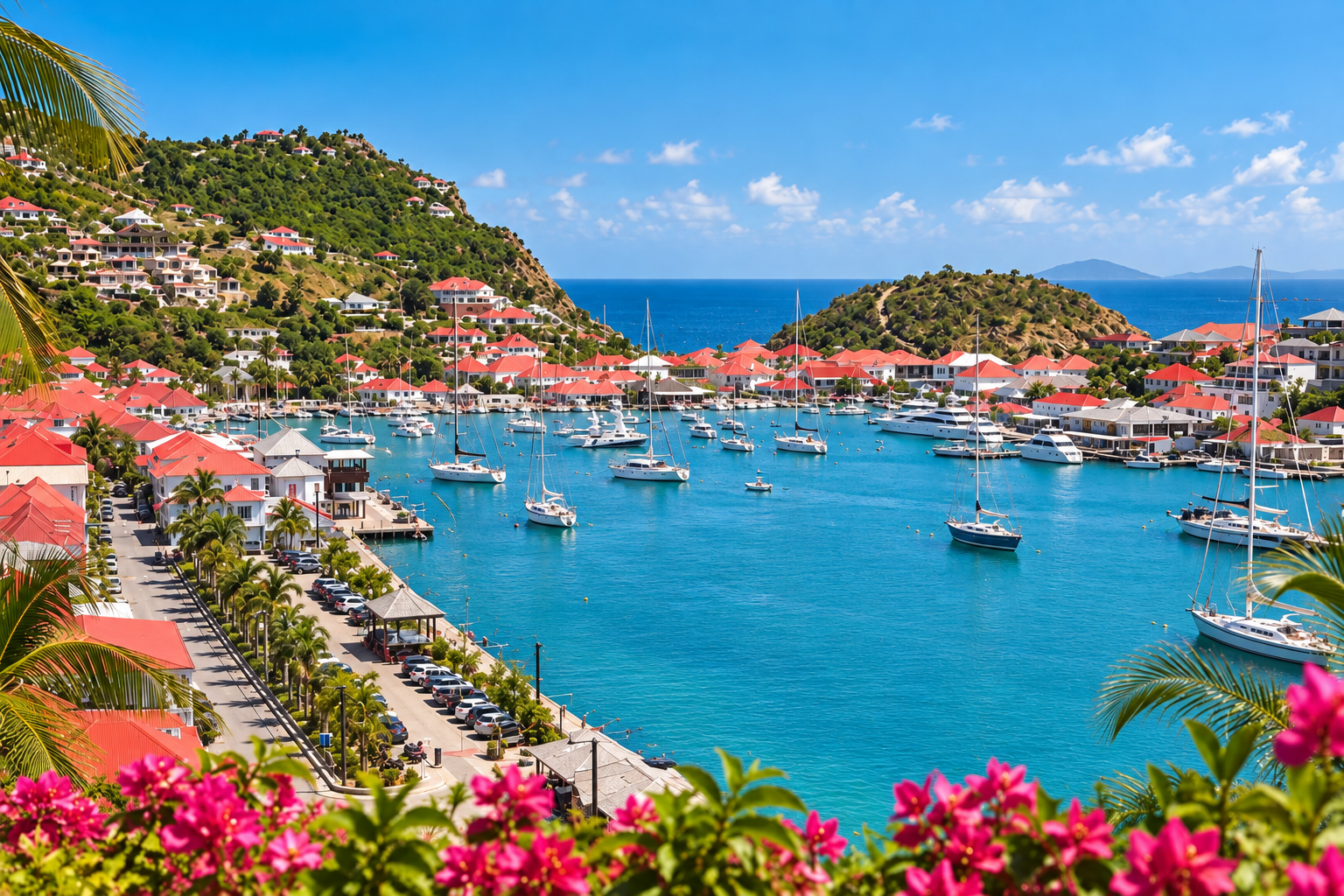
It is 6:30 pm and the light is changing over the harbor. The yachts — some stretching beyond fifty meters of hull — have started to glitter on the calm water of the roadstead, while the boutiques draw their shutters and restaurant terraces begin to fill. This is the hour that Gustavia regulars know well: the one that shifts Saint-Barthélemy's capital from active-town mode to island-evening mode. Since Valérie first set foot on the island in 1993, this transition between day and night remains one of the most striking moments Saint-Barth offers. And it unfolds in Gustavia.
This guide gives you an insider's bearings: history, harbor, shopping, gastronomy, culture and — above all — why some visitors choose to rent a villa in Gustavia, Saint-Barthélemy, rather than anywhere else on the island.
A town whose name carries Swedish history
Before being called Gustavia, the settlement bore a more modest name: Le Carénage — the careening place, where boats came to have their hulls scraped in the shelter of the bay. Everything changed on 1 June 1784, when Louis XVI ceded the island to Sweden's King Gustav III in exchange for warehousing rights in Gothenburg.[1] For both crowns, the transaction was calculated: France shed a deficit colony, Sweden joined the ranks of Caribbean colonial powers.
On 7 September 1785, Gustavia was declared a free port by Swedish royal decree: tax-free, open to all flags.[2] The status quickly attracted traders from the Antilles, North America and Europe. The town prospered particularly during the Napoleonic Wars thanks to its neutrality during the continental blockade.[1] In 1787, the settlement was officially renamed Gustavia in honor of King Gustav III.[1] At its peak in the early nineteenth century, the town had roughly 3,900 inhabitants.[1]
History reversed mid-century: fires, earthquakes and a slow commercial decline reduced the island's economic appeal. On 10 August 1877, France and Sweden signed a restitution treaty in exchange for 320,000 francs paid by the island's own population.[3] A buyback by the inhabitants — unusual in colonial history. In 1878, Saint-Barthélemy officially returned to France. The condition the islanders set for accepting this return? Retention of the free-port status, still in force today.[3]
The legacy of this Swedish interlude (1784–1878) can still be read in the streets: some buildings display plaques with period names, the stone-base architecture typical of the Gustavian era punctuates the urban fabric, and the Swedish flag flies alongside the tricolor on the Collectivité buildings.
The harbor — a roadstead for the world's yachts
Gustavia's geography is its first advantage: the bay offers one of the most sheltered natural anchorages in the Lesser Antilles, protected from the dominant trade winds. Today, Port de Gustavia provides about 300 berths for vessels up to 60 meters in length, including some thirty visitor quayside berths and roughly 200 mooring buoys.[4] Water depth reaches 8 meters at the outer harbor, sufficient for the longest superyachts the port accepts.[4] The mooring method is Mediterranean: bow anchor with stern to the quay.
The most anticipated nautical events take place here. The Bucket Regatta — gathering the world's largest classic yachts each March — and Les Voiles de Saint-Barth — the competitive regatta held each April — transform the harbor into a high-seas stage.[5] If you are planning a stay during these periods, our high-season guide to Saint-Barthélemy provides the dates and booking advice you need.
At any time of day, a walk around the harbor — from the Quai de la République to the breakwater — is a complete activity in itself: watching crews, reading flags of nationality, watching a catamaran dock from Sint Maarten. Free, no ticket, no queue.
Shopping — the free-port advantage in practice
Saint-Barthélemy has duty-free status: no VAT is levied on purchases made on the island.[6] This is a rare advantage in the Caribbean, and it translates into competitive pricing at the international boutiques established in Gustavia.
The three main shopping streets are:
- Quai de la République — luxury houses along the harbor front: Cartier, Bulgari, Chopard[6]
- Rue du Général de Gaulle — international brands alongside more discreet addresses[6]
- Rue du Roi Oscar II — a mix of local designers and upmarket ready-to-wear[6]
Alongside the major houses — Louis Vuitton, Prada, Hermès, Dolce & Gabbana, Ralph Lauren[6] — several local boutiques deserve attention:
- Poupette St Barth: the brand that defined the island's beach-bohemian aesthetic since the 1990s[7]
- St Barth French West Indies: a local fashion institution founded in 1989[7]
- Clic Gallery: a hybrid gallery of fashion, design and publishing — as much a place to wander as to buy[7]
Practical: most boutiques close between noon and 3 pm, and remain closed on Wednesday afternoons.[7] The best shopping window is the morning, from 9:30 am to noon.
Gastronomy and nightlife in Gustavia
Gustavia concentrates a large share of the island's restaurants, across a range from neighborhood bar to gastronomic table.
Le Select is the obligatory starting point. Founded in 1949 by Marius and Helen Stakelborough, it is the oldest bar on the island.[8] In the 1970s, musician Jimmy Buffett used it as his preferred workplace and drew his inspiration for Cheeseburger in Paradise, one of his most-played songs.[8][9] Nothing has changed since: tables under trees, cold beers, burgers — deliberate informality in a harbor that also receives yachts worth tens of millions of dollars.
Bonito, opened in 2009 by chef-owner Laurent Cantineaux, offers French-Caribbean cuisine with Latin American accents, in a dining setting elevated above the harbor.[10] One of the island's more durable addresses in a restaurant scene that changes frequently.
On the nightlife front, Gustavia is contained — this is not an island for nights that last until dawn. Bagatelle animates evenings on the harbor edge with a dinner-DJ format, the music building from around 10 pm.[11] Bar de l'Oubli, in the center of Gustavia, is the sunset aperitif address, with a terrace that sees the whole town pass by.[11] For a panoramic view over the harbor, some prefer starting the evening at Ociela — also known as Barry Rooftop —, perched with an unobstructed view of the masts.[11]
The evening rhythm is Mediterranean: aperitif around 7 pm, dinner starting properly after 8:30 pm, atmosphere building after 11 pm. If you are staying in a villa in Gustavia, all of this is walkable.
Cultural and natural landmarks
The Wall House territorial museum
At 2 rue de Pitea, at the Pointe de Gustavia, the Wall House occupies one of the largest buildings from the Swedish era, constructed between 1791 and 1801 — exact date uncertain.[12] Its history is itself a summary of the island's: theater, hotel or trading post depending on the account — the building had several lives before being left in ruins after a fire in the mid-nineteenth century. It was restored in 1995 by the Compagnons du Devoir.[12][13]
Today, the ground floor holds a permanent collection — photographs, objects, period costumes — tracing the major periods of Saint-Barthélemy's history.[13] Entry is free.[13] Indicative opening hours [À VÉRIFIER — confirm before visiting at saintbarth-tourisme.com or by phone at +590 590 29 71 55]: Monday, Tuesday, Thursday, Friday 9:30 am–12:30 pm and 3:00–7:00 pm; Wednesday 2:00–7:00 pm; Saturday 9:30 am–1:00 pm.
Fort Karl
To the west of Gustavia, Fort Karl is one of three defensive works built by the Swedes to protect the roadstead, alongside Fort Gustav and Fort Oscar.[14] Named in honor of Duke Karl of Södermanland (the future Karl XIII), brother of King Gustav III, it is today managed by the Conservatoire du littoral.[14] From the top of the hill — roughly 34 meters — the view over Gustavia Bay and the island's north coast is one of the clearest in the neighborhood, particularly at sunset.
Shell Beach
Ten minutes on foot from the harbor, Shell Beach — Plage des Grands Galets — is distinctive for its millions of polished shells that have replaced ordinary sand, giving the beach a characteristic pink tint.[15] The water is calm, and on clear days the view extends to Saba and Saint-Eustatius.[15] A beach restaurant allows lunch with your feet in the shells.
Renting a villa in Gustavia, Saint-Barthélemy: what you need to know
Staying in Gustavia is a lifestyle choice rather than a beach choice. There is no large sandy beach immediately at hand — Shell Beach is beautiful but unusual. In return, the town's life — restaurants, galleries, harbor walks — is reachable on foot from almost every property in the neighborhood. It suits travelers who want to experience the island as a resident: dinner out without a car, a morning walk along the quay with coffee, returning to the villa after an evening in town.
Properties elevated above the harbor frequently offer terraces with views over the roadstead and its yachts. In high season, that view justifies the address.
Our villa selection in Saint-Barthélemy covers all neighborhoods of the island, including Gustavia and its surroundings. Our concierge service can arrange restaurant reservations, transfers from SXM, SJU or ANU, and a private chef for evenings when you would rather stay dockside.
Frequently asked questions about Gustavia
Do you need a car in Gustavia? Gustavia is the most walkable part of the island: shops, restaurants, the harbor and the museum are all reachable on foot. For more distant beaches — Colombier, Saline, Gouverneur — a rental car or driver service is still necessary. Our concierge team can arrange this on arrival.
Is there a beach in Gustavia? Shell Beach is ten minutes on foot from the harbor. It is not a sandy beach but a cove covered in natural shells. The water is clear and calm, ideal for swimming. If you prefer fine sand, Saint-Jean is fifteen minutes by car.
When is the best time to visit Gustavia? The harbor is lively from December to April, peaking during the regattas (Bucket Regatta in March, Voiles de Saint-Barth in April). The low season (June to August) sees boutiques keep reduced hours and some restaurants temporarily close. Gustavia is accessible year-round, but high season is when it shows its full character.
How do you reach the island from Europe or the United States? Saint-Barth airport (SBH) is served by small aircraft from Saint Martin (SXM), San Juan (SJU) and Antigua (ANU). Port de Gustavia also receives ferry services from Saint Martin. Our concierge service manages transfers from any of these entry points.
Is shopping in Gustavia genuinely cheaper than in France? Saint-Barthélemy is a free-trade zone: no VAT is applied to purchases, unlike mainland France (20%) or most other European destinations.[6] For luxury goods in particular, the difference is tangible.
Our recommendation
Gustavia is not Saint-Barth's neighborhood for vacationers seeking a beach in front of their terrace. It is the neighborhood for those who want a human-scale island, where you stroll along the quay in the evening with a glass in hand, and where Swedish history surfaces in every architectural detail. If you are weighing neighborhoods, contact Valérie — on the island since 1996, she will help you find the villa that matches your way of experiencing Saint-Barth.
- Gustavia (Saint-Barthélemy) — Wikipédia [cross-reference] — https://fr.wikipedia.org/wiki/Gustavia_(Saint-Barth%C3%A9lemy) — accessed 02/07/2026 ↩
- La seule capitale française des Caraïbes qui porte le prénom d'un roi suédois depuis 1784 — journee-mondiale.com — https://www.journee-mondiale.com/la-seule-capitale-francaise-des-caraibes-qui-porte-encore-le-prenom-d-un-roi-suedois-depuis-1784-12797.htm — accessed 02/07/2026 ↩
- Swedish colony of Saint Barthélemy — Wikipedia (en) [cross-reference] — https://en.wikipedia.org/wiki/Swedish_colony_of_Saint_Barth%C3%A9lemy — accessed 02/07/2026 ↩
- Port de Gustavia — Superyacht Services Guide — https://www.superyachtservicesguide.com/20/13791/port-de-gustavia ; figaronautisme.meteoconsult.fr — accessed 02/07/2026 ↩
- Les Voiles de Saint-Barth (official) — https://www.lesvoilesdestbarth.com ; Bucket Regatta (official) — https://bucketregatta.com — accessed 02/07/2026 ↩
- Boutiques de Saint-Barth — Saint Barth Tourisme (official) — https://www.saintbarth-tourisme.com/boutiques-saint-barth/ — accessed 02/07/2026 ↩
- Shopping Saint-Barth — WIMCO Villas — https://www.wimco.com/villa-rentals/caribbean/st-barthelemy/shopping ; access.sb — accessed 02/07/2026 ↩
- Le Select — stbarth.com (local press) — https://saintbarth.com/visit-gustavia-gem-le-select/ — accessed 02/07/2026 ↩
- Le Select St Barts — Caribbean Compass — https://caribbeancompass.com/le-select-st-barts/ — accessed 02/07/2026 ↩
- Bonito Saint Barth — official site — https://www.bonitosbh.com/ — accessed 02/07/2026 ↩
- Gustavia nightlife — cyriljarnias.com, uniquevillastbarth.com, stbarthvip.com — accessed 02/07/2026 ↩
- Wall House Museum — Musées de Saint-Barth (official) — https://www.museesstbarth.com — accessed 02/07/2026 ↩
- Territorial Museum Wall House — Saint Barth Tourisme (official) — https://www.saintbarth-tourisme.com/en/territorial-museum-wall-house/ — accessed 02/07/2026 ↩
- Fort Carl — Agence de l'Environnement de Saint-Barth (official) — https://www.agencedelenvironnement.fr/en/page/discover-fort-carl ; Karl Fort — Saint Barth Tourisme (official) — https://www.saintbarth-tourisme.com/en/karl-fort-2/ — accessed 02/07/2026 ↩
- Shell Beach — saint-barths.com, access.sb — accessed 02/07/2026 ↩