St Barth Film Festival: five nights of Caribbean cinema under the open sky
Every late April, Saint-Barthélemy hosts the St Barth Film Festival: free Caribbean cinema at Gustavia, Lorient and Flamands. A practical guide.
By Sun Beach House
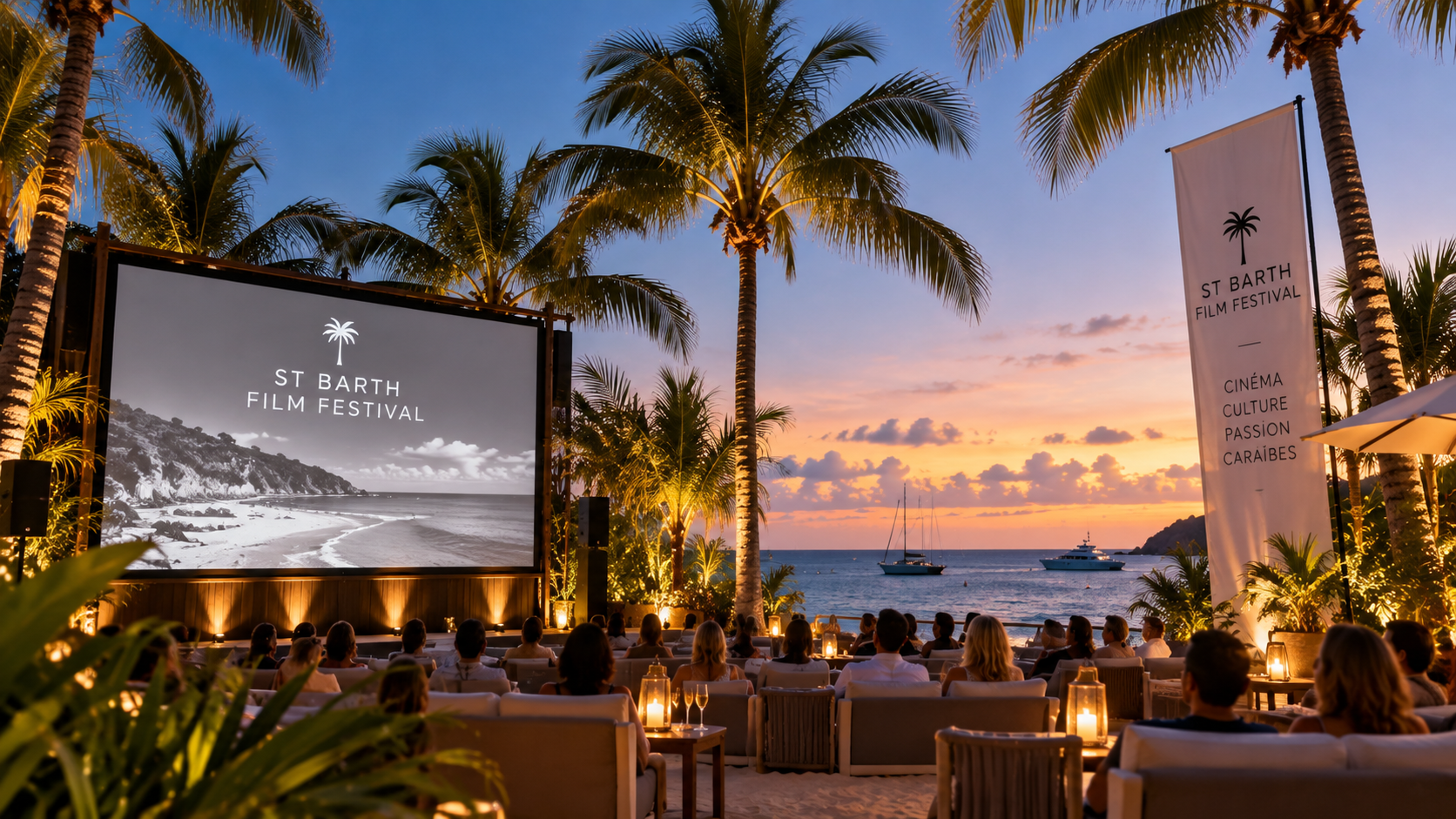
Every late April, once the high-season yachts have set sail and the island catches its breath, something unexpected unfolds on the dock at Gustavia. Chairs line up facing a screen, light fades over the red rooftops of the capital, and a voiceover announces the first film of the evening — shot in Martinique, Haiti, or Guadeloupe, in settings that most visitors to Saint-Barthélemy have never seen.
Since 1996[1], the St Barth Film Festival — officially the Festival du Film et du Cinéma Caraïbe de Saint-Barthélemy — has given the island an open window onto Caribbean filmmaking. Free admission, outdoor screens, directors on hand to answer questions from the public: a festival that chose accessibility over prestige, and has held to that choice for thirty years.
For those who discover Saint-Barth off-season, it is one of the island's most rewarding surprises — and one of its least-known.
A festival born of a conviction: Caribbean cinema deserves an audience
When the festival was founded in 1996[1], films from the French-speaking islands — Martinique, Guadeloupe, Haiti, Réunion — had virtually no distribution circuit within the Caribbean. They rarely travelled from one island to another.
Saint-Barthélemy, a French island shaped by international tourism, was in a peculiar position: an educated, cosmopolitan public with no access to the cinema of its immediate region. The festival's founding idea was simple: create an annual meeting place between Caribbean filmmakers, their local audience, and the visitors who happen to be on the island during the festival. Thirty years later[1], that wager has paid off.
Each edition brings together around a dozen films[2] — features, shorts and documentaries — all in French or with French subtitles[2], making them accessible to an international audience while remaining consistent with the island's language.
Screening venues: three settings, one island
What sets the festival apart from its counterparts is the nature of its screening spaces. No air-conditioned cinema, no covered amphitheatre: everything happens outdoors, under the Caribbean sky.
AJOE in Lorient: the heart of the festival
The main venue is the open-air cinema at AJOE (Association Joyeux Organisateurs d'Événements) in Lorient, on the northern coast of the island[2]. This community site hosts most of the evening screenings. The setting is deliberately simple: chairs facing a screen, salt-tinged air, a sky that slowly turns from deep orange to black between sunset and the first frame of film.
Gustavia: the dock and the Théâtre du Paradis
The capital offers two configurations. Screenings on the dock at Gustavia[2] — with moored boats and harbour lights as backdrop — evoke the kind of open-air cinema that has largely disappeared from the rest of the world. The Théâtre du Paradis, also in Gustavia[2], hosts certain screenings in a more intimate setting.
Flamands: the beach, when conditions allow
In some editions, the festival makes use of Flamands beach[2] for nighttime screenings. Flamands is Saint-Barthélemy's longest beach — more than a kilometre of sand, facing the Atlantic. Watching a film seated or lying in the sand, with an ocean horizon as backdrop, is an experience very few festivals in the world can offer. These screenings are not guaranteed every year and depend on the specific edition.
A programme built around dialogue
The festival selects around a dozen films each year[2] — features, documentaries, animated shorts — from across the Caribbean and the French-speaking world. Programming favours diversity: a first film by a young Martinican director sits alongside a documentary on traditional Haitian music or a Guadeloupe fiction feature.
Each edition includes a public roundtable on Caribbean cinema[4], open to all, with directors, producers and audiovisual professionals invited for the occasion. For visitors genuinely interested in cinema beyond the spectacle, this roundtable is often the most irreplaceable moment of the festival.
The festival also runs filmmaking workshops in the island's schools[4], where invited directors introduce students to camera work, editing and narrative structure as a possible career, not simply as spectacle.
April in Saint-Barth: a season few visitors know
The festival falls at the end of April, in the transition between high season (December-April) and low season (May-November). At this time of year, Saint-Barthélemy shows a face its December visitors rarely see.
Beaches are quieter. Restaurants are still open — closures typically begin in May. The weather is favourable: 26 to 28 °C, moderate humidity, brief showers that rarely affect evening screenings. Villa rental rates are more accessible than at the peak of high season, opening a week on the island to travellers who would not consider Saint-Barth in December.
For those looking for a combination of beach holiday and cultural experience, the festival week offers a rare balance: days free for swimming and sailing, evenings dedicated to cinema.
Our villa selection at Saint-Barth includes properties available by the week, across all neighbourhoods of the island. Several are a short drive from Lorient and Gustavia, the festival's main venues.
How to organise your visit
Admission: all screenings are free and open to the public[2]. No ticket, no reservation — arrive before the screening starts.
Programme: published on the official festival website (stbarthff.org) two to three weeks before each edition.
Getting around: a rental car is the most practical way to move between venues. If you are staying in Lorient, the AJOE is within walking distance. For screenings in Gustavia or Flamands, a car or taxi is recommended.
Practical tips: arrive early for the best seats, especially at Lorient. Bring a light layer for the evening — April nights can be cool under the trade wind. Check the programme before arriving to identify which screenings interest you most.
To organise your villa, transfers and activities during the festival, our concierge team is available to assist.
Frequently asked questions
Are screenings really free? Yes. All screenings are free and open to the public[2]. The festival has made accessibility its founding principle since 1996.
Do I need to speak French to enjoy the festival? All films are in French or have French subtitles[2]. Visually rich documentaries and animated films remain accessible even for non-French speakers.
How many films are shown per edition? Around a dozen[2], spread over four to five days, with one to two screenings per evening depending on the venue.
Will the 30th edition have a special programme? The 30th edition is expected in late April 2027 and marks an important anniversary for the festival. Its official programme had not yet been announced at the time of writing; it will be published on the festival's website.
Can I combine the festival with diving or sailing? Yes. Screenings take place in the late afternoon and evening, leaving mornings and afternoons free for nautical activities, day boat rentals, or simply the beach.
A quiet event, for those who know
The St Barth Film Festival is not a spectacle event. There are no red carpets, no celebrity press tours. What happens there is quieter, and in its own way more valuable: films you would probably not have seen elsewhere, presented by the people who made them, in a setting that no cinema hall can replicate.
If you are considering a visit to Saint-Barthélemy outside high season, the festival is a compelling reason to plan your stay around the last week of April. To book a villa for the festival week or organise your stay, our Saint-Barth concierge team is here to help.
- St. Barth Film Festival — official website, "About the Festival" — https://www.stbarthff.org/about-the-festival — accessed 31/08/2026 ↩
- St. Barth Film Festival — Wikipedia (cross-reference, confirmed by sources 1, 3 and 4) — https://en.wikipedia.org/wiki/St._Barth_Film_Festival — accessed 31/08/2026 ↩
- Le Journal de Saint-Barth — "St. Barth Film Festival - Gros plan sur le patrimoine caribéen" — https://www.journaldesaintbarth.com/en/actualites/vie-locale/st-barth-film-festival-gros-plan-sur-le-patrimoine-caribeen-202604232111.html — 23 April 2026 — accessed 31/08/2026 ↩
- St. Barth Film Festival — official website, "About" — https://www.stbarthff.org/about — accessed 31/08/2026 ↩