A day in Saint-Barth, by Valérie
Valérie, founder of Sun Beach House, takes you through a full day in Saint-Barth: Flamands, the Colombier trail, Grand Cul-de-sac, Corossol and Gustavia at dusk.
By Sun Beach House
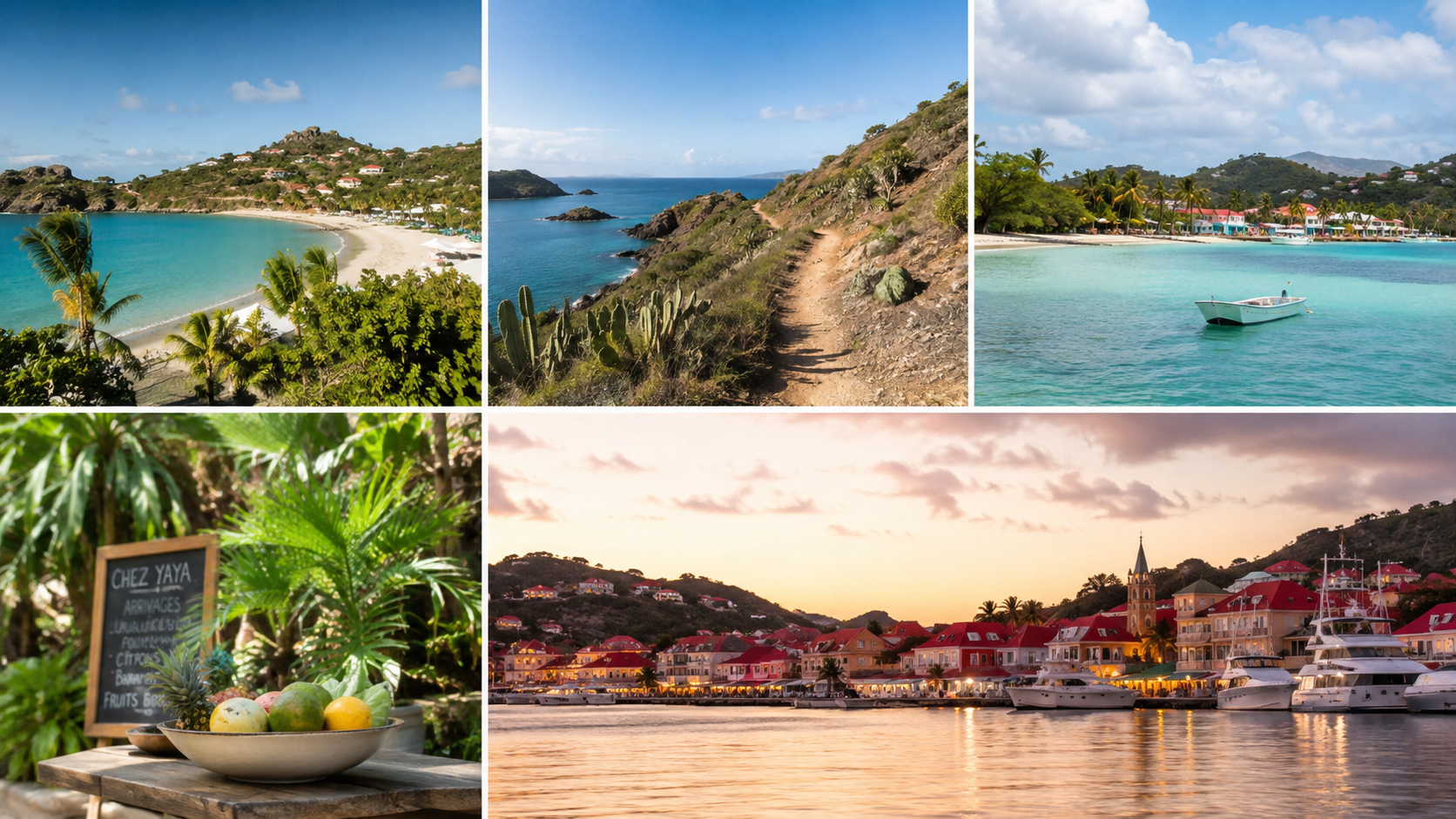
The first time I saw Flamands — a beach stretching nearly eight hundred metres, facing the sun rising over the latanier hills — I knew I wouldn't be leaving anytime soon. That was 1993. Since then, I've had the privilege of living here, crossing this island in every direction, knowing it by heart in the early morning before the island wakes.
Saint-Barthélemy is twenty-five square kilometres[1]. You might think that's an hour's drive. In reality, a well-built day on this island feels less like a tourist circuit and more like a conversation: each place leads naturally to the next, each light calls the one that follows. What I'm offering here isn't a checklist. It's the day I'd design if I had just one chance to show Saint-Barth to someone I love.
07:00 — Flamands: start at the longest beach
Flamands is on the northwest side of the island[2]. Saint-Barth's longest beach — around eight hundred metres of fine white sand — stays quiet in the morning. No motorised craft, no rows of parasols. The sea is generally calm at that hour, the Atlantic swell softened by the shape of the bay.
Taïwana and Cheval Blanc are both here — two addresses that know how to stay discreet within the landscape. But at sunrise, what matters is the light on the water and the absence of noise. I arrive early, lay down my towel, and let the morning pass.
If you're staying in a villa near Flamands or Colombier, you're five minutes away. Otherwise, allow about twenty minutes from Gustavia. Parking is free and right on the beach.
09:30 — The Colombier trail: where the island remembers itself
From Petite Anse, a trail descends to Colombier[3]. About seven hundred and fifty metres of rocky path, twenty to thirty minutes at a comfortable pace. No road, no car access: Colombier beach can only be reached on foot or by sea.
This beach is part of the Nature Reserve of Saint-Barthélemy, created on 10 October 1996[4]. Twelve hundred hectares of protected nature. Green and hawksbill sea turtles frequent the water — a mask and snorkel is enough to see them without venturing far from the shore. The large rock to the east gives a clear view toward Sint Maarten on good days.
I often bring guests here who think they've already seen everything Saint-Barth has to offer. Colombier reminds them that the island has a longer memory than the high season.
12:30 — Grand Cul-de-sac: the northeast lagoon
From Colombier, you cross the whole island to reach Grand Cul-de-sac on the northeast coast[5]. It's the opposite of Colombier: a shallow lagoon, sheltered by a coral reef, with turquoise water that recalls Polynesian lagoons. The water is calm, depth modest — ideal for kitesurfing, with the 7th Heaven school operating here for several seasons.
For lunch, La Gloriette [TO VERIFY — check current operating status before publication] was the reference address on this beach: a terrace under cocoloba palms, refined Creole cuisine, artisanal rum to finish. The setting remains one of the most beautiful on the island, facing the lagoon.
You can also simply rent a kayak, paddle across the lagoon, and watch the sea turtles that frequent the seagrass beds. Le Guanahani, Sereño and Le Barthélemy hotels all border this bay — but the beach remains open to all.
15:30 — Corossol: the island's oldest village
Corossol is twenty minutes from Grand Cul-de-sac, on the west coast, a short distance from Gustavia[6]. It's the most preserved fishing village on the island. Dories are still pulled up on shore. Some residents still speak the Norman dialect — the idiom the first settlers brought in the seventeenth century from Normandy and Brittany.
The tradition of weaving latanier leaves dates to the late nineteenth century: Father Morvan is said to have taught it around 1890, and passed it on[7]. The latanier chapels carried during Easter processions are among the most intimate images of the island — rarely seen in travel magazines.
The Inter Oceans Museum, founded by Ingénu Magras, holds more than nine thousand shell specimens from around the world — Japan, Hawaii, Australia, Africa, Latin America, the Caribbean[8]. It's a private collection displayed in a family home. [TO VERIFY — confirm the museum is still open and check current hours before publication.]
Corossol can't be done in ten minutes if you take the time to observe it. I recommend walking without a fixed itinerary.
18:30 — Gustavia: golden hour on the harbour
Gustavia at 18:30 is the best moment of the day in the capital[9]. The sun descends over Fort Oscar — built in 1787 during the Swedish period, in honour of King Gustav III. The light catches the red of the flamboyant trees; the boats in the harbour reflect blue.
I often start at Bar de l'Oubli, on Rue du Bord de Mer, for a drink facing the harbour. Then Le Select, Rue de la France — the oldest bar on the island, founded in 1949 by Marius and Hélène Stakelborough[10]. Jimmy Buffett wrote Cheeseburger in Paradise there in 1978. Marius Stakelborough passed away in 2020, aged 97.
For those who prefer the Atlantic view over the harbour view, the Christo Bar at Hotel Christopher (Pointe Milou) is open to non-guests and looks out over the open Atlantic.
20:30 — Dinner: in the villa or at a restaurant
If you're staying in a villa with our concierge service, the best option is often a private chef at home. A meal prepared in your own kitchen, on your terrace, with local produce — red snapper, lobster, passion fruit — and no need to drive after dinner.
If you prefer to go out, two reliable addresses in Gustavia: Le Repaire, open since 1991, from 7:00 AM[11], with a menu that works at any hour. And Bonito, founded in 2009 by Laurent Cantineaux[11], for French-Asian cuisine on a terrace overlooking the harbour.
Saint-Barthélemy has around eighty restaurants across twenty-five square kilometres. But dinner in a villa remains, for me, what best captures what this island offers to those who truly choose it.
Frequently asked questions
How long does it take to see the best of Saint-Barth?
A well-organised day covers a lot — the northwest, northeast, west and Gustavia. But the island truly reveals itself over three to five days: each beach has its own character depending on the time of day and season.
Which beach is best for families with children?
Grand Cul-de-sac, thanks to its shallow lagoon and calm water. Saint-Jean is also suitable — the beach is sheltered by a coral reef and conditions are consistent.
Is a car necessary in Saint-Barth?
Yes. Distances are short (twenty-five square kilometres), but the roads are steep and taxis can be scarce at certain hours. A Mini Moke or small SUV is the norm. Our concierge service can arrange the rental from your arrival.
How do you book a private chef for the villa?
Through your rental agency or directly with our concierge service. Private chefs available on the island work by reservation, often several days in advance during high season. It's advisable to book at the same time you confirm your villa.
Flamands or Saline: which to choose?
Flamands for calm and length of sand — ideal in the morning. Saline for its more intimate feel and crystal-clear water — ideal mid-day. Both are worth visiting; they are nothing alike.
Our recommendation
I've lived this day dozens of times in different forms — with families, couples, friends passing through. What doesn't change is the quality of the light at Flamands in the morning, and what people say when they climb back up from the Colombier trail.
If you're planning a stay in Saint-Barth and would like help building your programme — villa, chef, water activities, transfers — contact us or browse our villa selection. This is what we've been doing since 1996.
- Régions-et-départements.fr — Saint-Barthélemy — 25 km² — https://www.regions-et-departements.fr/collectivites-doutre-mer/97133-saint-barthelemy — accessed 20/07/2026 ↩
- Office du Tourisme de Saint-Barthélemy — Flamands — https://www.saintbarth-tourisme.com/plage-flamands-saint-barth/ — accessed 20/07/2026 ↩
- Office du Tourisme de Saint-Barthélemy — Colombier — https://www.saintbarth-tourisme.com/plage-colombier-st-barth/ — accessed 20/07/2026 ↩
- Wikipedia — Nature Reserve of Saint-Barthélemy — https://en.wikipedia.org/wiki/Nature_Reserve_of_Saint_Barth%C3%A9lemy — accessed 20/07/2026 ↩
- Wikipedia — Anse du Grand Cul-de-Sac — https://en.wikipedia.org/wiki/Anse_du_Grand_Cul-de-Sac — accessed 20/07/2026 ↩
- Office du Tourisme de Saint-Barthélemy — Corossol — https://www.saintbarth-tourisme.com/en/destination-item/corossol-2/ — accessed 20/07/2026 ↩
- Collectivité de Saint-Barthélemy — traditions — https://www.comstbarth.fr/baignade — accessed 20/07/2026 ↩
- Office du Tourisme de Saint-Barthélemy — Corossol / Inter Oceans Museum — https://www.saintbarth-tourisme.com/en/destination-item/corossol-2/ — accessed 20/07/2026 ↩
- AFAR — Fort Gustaf — https://www.afar.com/travel-guides/saint-barthelemy/guide — accessed 20/07/2026 ↩
- Caribbean Compass — Le Select — https://caribbeancompass.com/le-select-st-barts/ — accessed 20/07/2026 ↩
- Access.sb / Gustavia Harbor — Le Repaire and Bonito — https://access.sb/en/st-barts/restaurants/ — accessed 20/07/2026 ↩